
This calculator is for general information only and is not medical advice. Speak to a doctor or qualified professional before making changes to your diet or training.
FFMI Calculator
Fat-Free Mass Index & Normalized FFMI
Categories are general community reference ranges, not a medical diagnosis. Results depend on how accurate your body fat percentage is.
FFMI Calculator: Fat-Free Mass Index & Normalized FFMI
FFMI (Fat-Free Mass Index) tells you how much lean tissue, mostly muscle, you carry for your height. You get it by dividing your fat-free mass in kilograms by your height in metres squared. For most men an FFMI of 18 to 20 is average, 22 to 23 is excellent, and a normalized score above about 25 is rare without performance-enhancing drugs. For women the typical range sits roughly 14 to 17. Enter your height, weight and body fat percentage in the calculator below to see your FFMI, your height-adjusted (normalized) FFMI, and where you stand.
How to use the FFMI calculator
- Choose metric (kg and cm) or imperial (lb and feet/inches).
- Select your sex, because the reference ranges for men and women are different.
- Enter your height and your body weight.
- Enter your body fat percentage. This is the most important input, so use the best measurement you have (see the accuracy section below).
- Press Calculate FFMI. You will see your FFMI, your normalized FFMI, your lean mass, and a rating on a simple scale.
If you do not know your body fat percentage, run our Body Fat Percentage Calculator first and come back with that number.
FFMI formula
The maths is simple:
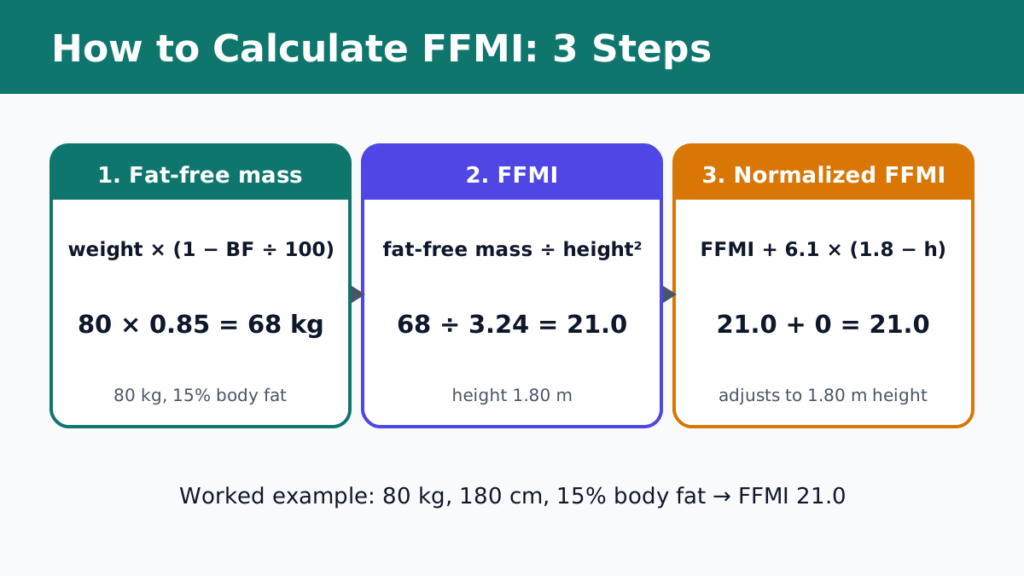
Fat-free mass (kg) = body weight × (1 − body fat % ÷ 100)
FFMI = fat-free mass (kg) ÷ height (m)²
Fat-free mass means everything in your body that is not fat: muscle, bone, organs, water and connective tissue. Because it is not only muscle, FFMI is an estimate of muscularity, not a perfect measure of it.
Normalized FFMI
Taller people tend to score a little higher on raw FFMI simply because they are bigger overall. To make scores comparable, researchers adjust to a reference height of 1.8 m (about 5 ft 11 in):
Normalized FFMI = FFMI + 6.1 × (1.8 − height in metres)
When you compare yourself with charts or with other lifters, use the normalized number.
Worked examples
Example 1: average gym-goer (male). 80 kg, 180 cm, 15% body fat. Fat-free mass = 80 × 0.85 = 68 kg. Height squared = 1.8 × 1.8 = 3.24. FFMI = 68 ÷ 3.24 = 21.0. Normalized FFMI = 21.0, because he is exactly 1.8 m tall.
Example 2: tall lifter (male). 90 kg, 190 cm, 12% body fat. Fat-free mass = 90 × 0.88 = 79.2 kg. Height squared = 3.61. FFMI = 79.2 ÷ 3.61 = 21.9. Normalized FFMI = 21.9 + 6.1 × (1.8 − 1.9) = 21.9 − 0.6 = 21.3.
Example 3: female lifter. 60 kg, 165 cm, 22% body fat. Fat-free mass = 60 × 0.78 = 46.8 kg. Height squared = 2.7225. FFMI = 46.8 ÷ 2.7225 = 17.2. Normalized FFMI = 17.2 + 6.1 × (1.8 − 1.65) = 17.2 + 0.9 = 18.1.
FFMI chart
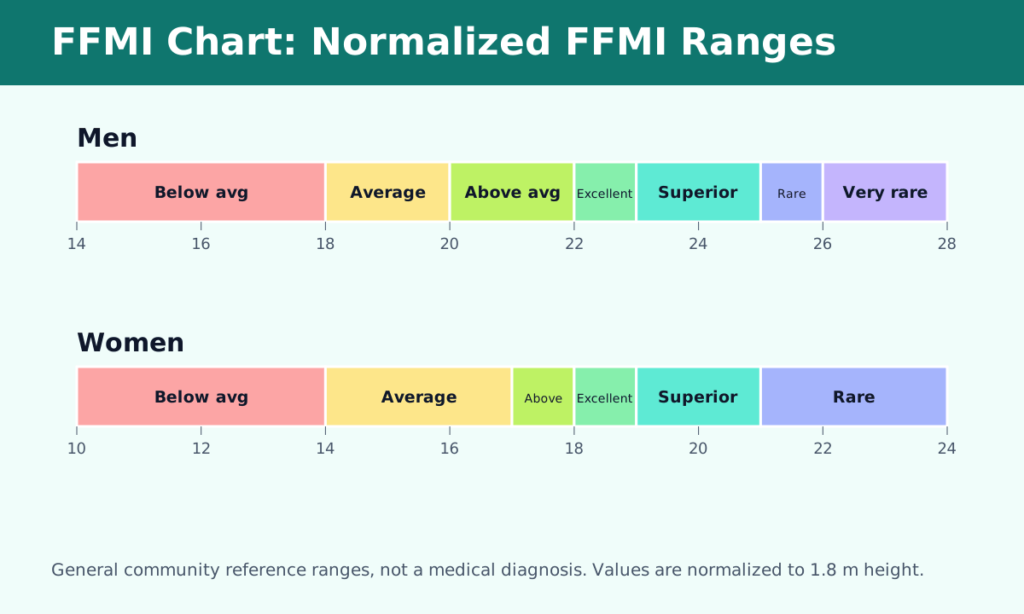
These ranges are widely used in the lifting community. They are reference points, not medical categories.
Men (normalized FFMI)
| Normalized FFMI | Rating |
|---|---|
| Below 18 | Below average |
| 18 – 20 | Average |
| 20 – 22 | Above average |
| 22 – 23 | Excellent |
| 23 – 25 | Superior |
| 25 – 26 | Exceptional, rare for natural lifters |
| Above 26 | Very rare naturally |
Women (normalized FFMI)
| Normalized FFMI | Rating |
|---|---|
| Below 14 | Below average |
| 14 – 17 | Average |
| 17 – 18 | Above average |
| 18 – 19 | Excellent |
| 19 – 21 | Superior |
| Above 21 | Exceptional, rare for natural lifters |
What is a good FFMI?
A good FFMI depends on your goals and your training history. Someone who has never lifted will usually land at the lower end of the average range. Most people who train consistently for a few years move into the above-average range. Reaching the excellent or superior range usually takes many years of structured training, good nutrition and favourable genetics.
Rather than chasing a single number, treat FFMI as a progress tracker. If your normalized FFMI rises over months while your body fat stays stable, you are adding lean mass.
Is an FFMI of 25 the natural limit?
The famous “25” comes from a 1995 study by Kouri and colleagues that compared athletes who used anabolic steroids with athletes who did not. The non-users clustered well below the users, and almost none of them reached about 25 on the normalized scale. That finding is why 25 became a rule of thumb.
It is a useful guide, but not a hard law:
- The study sample was limited, and the athletes were from a specific time period.
- Body fat was measured with skinfolds, which carry error.
- Some genetically gifted people may exceed 25 naturally, especially when body fat is estimated badly.
- A score above 25 is not proof of drug use, and a score below 25 is not proof of being natural.
Use the limit as a rough benchmark, not as a way to judge other people.
How accurate is FFMI?
FFMI is only as accurate as the body fat number you give it. A small error in body fat moves your result more than most people expect. For an 80 kg person who is 180 cm tall, a 3-point error in body fat changes FFMI by about 0.7 points.
Ways to measure body fat, from more to less precise:
- DEXA scan or a hydrostatic / Bod Pod test
- Skinfold calipers taken by an experienced person
- Bioimpedance scales (convenient, but sensitive to hydration)
- Tape-measure formulas such as the Navy method
Other limitations to keep in mind:
- Fat-free mass includes bone, water and organs, not only muscle.
- Very tall or very short people may not fit the normalization perfectly.
- Water retention, a recent meal or a heavy training day can shift the numbers a little.
- FFMI says nothing about strength, performance or health on its own.
FFMI vs BMI
BMI only looks at weight and height, so it cannot tell muscle from fat. A muscular person can be labelled “overweight” by BMI even with low body fat. FFMI fixes this by first removing fat mass, so it focuses on the lean tissue you actually built. If you lift weights, FFMI is usually more informative than BMI. You can compare both with our BMI Calculator.
How to increase your FFMI
Raising FFMI means building lean mass while keeping body fat under control. The basics matter most:
- Progressive overload. Train each muscle group about twice a week and gradually add weight, reps or sets over time.
- Enough protein. Research reviews suggest that benefits for muscle gain level off at around 1.6 g of protein per kg of body weight per day for most people, and some aim a little higher. Check your target with our Protein Intake Calculator.
- A modest calorie surplus. A small surplus supports muscle growth with less fat gain. Work out your numbers with our TDEE Calculator or our [Bulking Calculator].
- Sleep and recovery. Muscle is built during recovery, so aim for seven to nine hours of sleep.
- Patience. Gains slow down as you get closer to your genetic ceiling. Expect fast progress in the first year and much slower progress later.
Track your lean mass with the Lean Body Mass Calculator alongside FFMI.
How much muscle can I gain naturally?
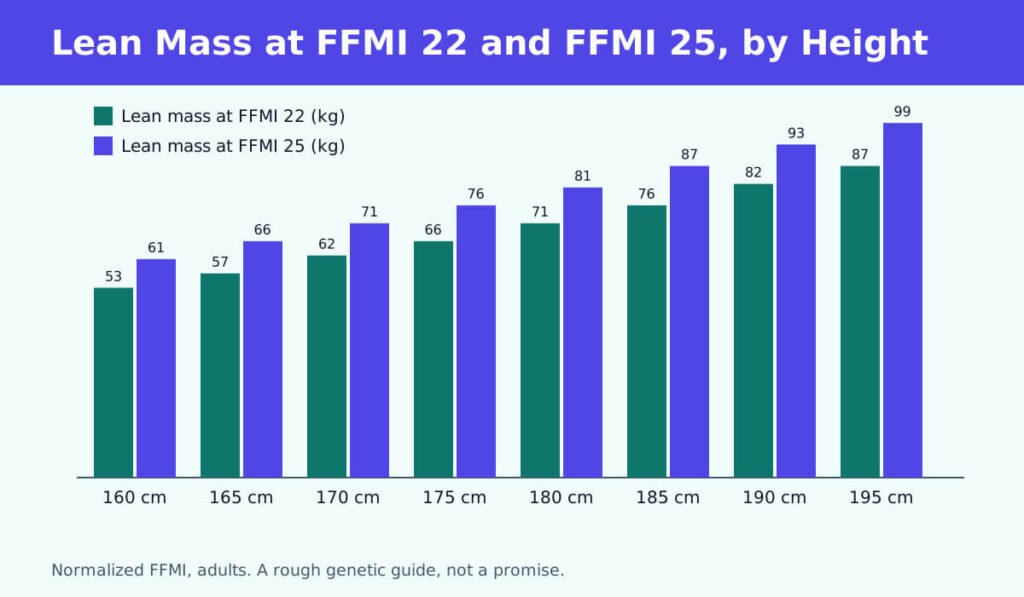
Your height decides how much lean mass sits behind a given FFMI. The table below turns two benchmark scores into real numbers: a normalized FFMI of 22 (a very muscular natural physique) and 25 (the commonly quoted natural ceiling). Body weight is shown at 12% body fat for the 25 column.
| Height | Lean mass at FFMI 22 | Lean mass at FFMI 25 | Body weight at FFMI 25 and 12% fat |
|---|---|---|---|
| 160 cm (5’3″) | 53 kg (117 lb) | 61 kg (134 lb) | 69 kg (153 lb) |
| 165 cm (5’5″) | 57 kg (127 lb) | 66 kg (145 lb) | 75 kg (164 lb) |
| 170 cm (5’7″) | 62 kg (136 lb) | 71 kg (155 lb) | 80 kg (177 lb) |
| 175 cm (5’9″) | 66 kg (146 lb) | 76 kg (167 lb) | 86 kg (189 lb) |
| 180 cm (5’11”) | 71 kg (157 lb) | 81 kg (179 lb) | 92 kg (203 lb) |
| 185 cm (6’1″) | 76 kg (168 lb) | 87 kg (191 lb) | 98 kg (217 lb) |
| 190 cm (6’3″) | 82 kg (180 lb) | 93 kg (204 lb) | 105 kg (232 lb) |
| 195 cm (6’5″) | 87 kg (192 lb) | 99 kg (217 lb) | 112 kg (247 lb) |
To estimate your own room to grow, subtract your current lean mass (from the calculator above) from the figure in your row. Treat the result as a rough genetic guide, not a promise. Many people never reach the 25 column, and that is completely normal.
FFMI by training experience
How fast your FFMI rises depends on how long you have trained, how well you eat and how responsive your genetics are. These are rough community guidelines for men, not scientific rules:
| Training history | Typical normalized FFMI (men) |
|---|---|
| Untrained | 17 – 19 |
| 1 year of consistent training | 18 – 20 |
| 2 – 4 years | 20 – 22 |
| 5+ years, well-planned training | 22 – 24 |
| Elite natural genetics | 24 – 25 |
Women usually sit about three to four points lower at every stage. Progress is fastest in the first one or two years and then slows down sharply. A rise of 0.5 to 1 FFMI point in a year is a good result for an intermediate lifter.
FFMI vs fat mass index (FMI)
FFMI has a twin called the fat mass index. It uses the same idea but for fat:
FMI = fat mass (kg) ÷ height (m)²
Together the two add up to BMI, because FFMI + FMI = BMI. Looking at both tells you far more than BMI alone. Two people can share a BMI of 25, yet one has an FFMI of 22 and an FMI of 3 (muscular and lean), while the other has an FFMI of 18 and an FMI of 7 (less muscle, more fat).
How to calculate FFMI manually or in Excel
You do not need a calculator for a quick check:
- Multiply your weight in kg by (1 − body fat % ÷ 100) to get fat-free mass.
- Convert your height to metres and square it.
- Divide the first number by the second.
In a spreadsheet, if weight is in A1 (kg), body fat % in B1 and height in metres in C1, the FFMI formula is =A1*(1-B1/100)/(C1^2). The normalized version is =A1*(1-B1/100)/(C1^2)+6.1*(1.8-C1). If you work in pounds and inches, multiply pounds by 0.4536 and inches by 0.0254 first.
Does FFMI change with age, cutting or bulking?
- Age: Lean mass tends to peak in early adulthood and decline slowly from around the age of 40 if you do not train. Regular strength training can slow this loss a lot, so FFMI is also a useful tracker for older lifters.
- Teenagers: The formula and charts were built for adults. A teenager who is still growing should not compare their FFMI with adult charts.
- Cutting: When you diet, your FFMI should stay roughly stable if you keep lifting and eat enough protein. A drop of more than about 0.5 points during a cut can mean you are losing muscle.
- Bulking: Your FFMI should rise slowly. If body weight climbs fast but FFMI barely moves, most of the extra weight is fat.
- Creatine: Creatine pulls water into muscle, so it can lift your measured lean mass by a kilogram or two within weeks. Part of that is water, not new muscle. See our Creatine Dosage Calculator for safe amounts.
Frequently asked questions
What does FFMI stand for?
FFMI stands for Fat-Free Mass Index. It compares your fat-free mass with your height, in the same way that BMI compares total weight with height.
What is a good FFMI for men?
For men, 18 to 20 is average, 20 to 22 is above average, and 22 to 25 is excellent to superior. Scores above 25 are very uncommon in natural lifters.
What is a good FFMI for women?
For women, roughly 14 to 17 is average, 17 to 19 is above average to excellent, and scores above about 19 to 21 are rare.
What is normalized FFMI?
Normalized FFMI is your FFMI adjusted to a reference height of 1.8 m, so that tall and short people can be compared fairly. The adjustment adds 6.1 times the difference between 1.8 m and your height.
Can a natural lifter have an FFMI above 25?
It is uncommon, but not impossible. The value of 25 is a statistical benchmark from research, not a strict biological limit. Inaccurate body fat measurements can also push scores up.
How do I find my body fat percentage for the calculator?
The most precise options are a DEXA scan or a Bod Pod. Skinfold calipers, a good bioimpedance scale or a tape-measure method will also give a usable estimate. Use the same method each time so you can track changes fairly.
Is FFMI used outside the gym?
Yes. Researchers and clinicians also use FFMI to screen for low muscle mass, for example in older adults or in people recovering from illness. The cut-offs used there are different from the lifting ranges above.
How often should I recalculate my FFMI?
Every four to twelve weeks is enough. Muscle changes slowly, and checking too often only measures day-to-day noise.
Is FFMI the same as lean body mass?
No. Lean body mass is a weight in kilograms or pounds. FFMI divides fat-free mass by height squared, which turns it into an index you can compare between people of different heights.
Is an FFMI of 20 good?
Yes. For a man, 20 is the point where you move from average into a fit, visibly trained physique. For a woman, 20 is already very high and sits close to the natural upper range.
Is an FFMI of 22 good?
For a man, 22 is excellent. It usually reflects several years of serious training and looks clearly muscular. For a woman, 22 is at or above what is usually seen in natural lifters.
Is an FFMI of 25 natural?
It is the commonly quoted natural ceiling for men, so it is possible but rare. Later research on college football linemen reported some players above 25, so it is not an absolute limit, and body fat measurement error can make a score look higher than it is.
What is the highest natural FFMI?
There is no confirmed exact figure. Most sources put the practical natural ceiling around 25 for men and around 21 to 22 for women, with a handful of genetic outliers above that.
What is the natural FFMI limit for women?
A commonly cited figure is about 21 to 22. Women’s scores run several points lower than men’s because women carry less lean mass on average.
What FFMI is average?
For adult men who do not lift, 18 to 19 is typical. For adult women who do not lift, 14 to 16 is typical.
Can I calculate FFMI without knowing my body fat?
No, body fat is required, because it decides your fat-free mass. If you do not have a measurement, use a body fat calculator or visual guide for an estimate, then treat the FFMI as approximate.
Is FFMI better than BMI?
For people who lift weights, yes. BMI cannot separate muscle from fat, so a muscular person can look overweight. FFMI removes the fat first, so it reflects muscle development much more fairly.
Can a high FFMI prove someone uses steroids?
No. A very high FFMI is unusual in natural lifters, but genetics, inaccurate body fat numbers and measurement method all affect the result. It is a statistical hint at best, never proof.
How long does it take to reach an FFMI of 22 naturally?
For most men with good training and nutrition, getting from average (18 to 19) to 22 takes roughly three to five years. Some people get there faster and many take longer.
Can my FFMI go down?
Yes. It can fall if you stop training, eat too little protein, diet too hard, are ill, or get older without strength training. It can also seem to fall because of a less accurate body fat reading.
Does creatine affect FFMI?
Creatine can raise measured lean mass slightly because muscles hold more water. Some of that increase is water rather than new muscle tissue.
Does FFMI include bone and organs?
Yes. Fat-free mass is everything that is not fat, including bone, organs, water and muscle. Because muscle is the part that changes most with training, FFMI is still a good guide to muscularity.
Is FFMI the same for men and women?
The formula is the same, but the reference ranges are different. Women have less lean mass on average, so always compare your result with the chart for your sex.
Key takeaways
- FFMI = fat-free mass (kg) ÷ height (m)². Use the normalized value to compare yourself with others.
- For men, 18 to 20 is average and 22 to 25 is a very high level. For women, 14 to 17 is average.
- Your result depends heavily on the accuracy of your body fat percentage.
- FFMI is a tracking tool, not a verdict on your health, effort or whether someone is natural.
References
- Kouri EM, Pope HG Jr, Katz DL, Oliva P. Fat-free mass index in users and nonusers of anabolic-androgenic steroids. Clinical Journal of Sport Medicine, 1995.
- Schutz Y, Kyle UUG, Pichard C. Fat-free mass index and fat mass index percentiles in Caucasians aged 18–98 years. International Journal of Obesity, 2002.
- Morton RW et al. A systematic review, meta-analysis and meta-regression of the effect of protein supplementation on resistance training-induced gains in muscle mass and strength. British Journal of Sports Medicine, 2018.