
Fetal Weight Estimator: Free EFW Calculator
Enter your ultrasound measurements to estimate baby weight with the Hadlock formula and see the growth percentile.
For education only. It does not diagnose anything and cannot replace your doctor’s assessment.
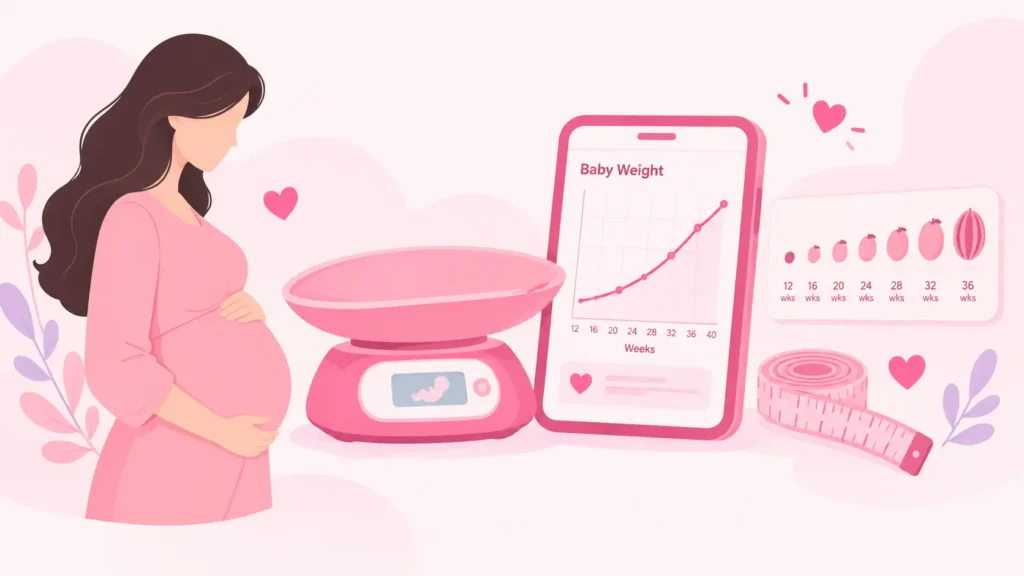
Fetal Weight Estimator: Free EFW Calculator for Your Baby’s Weight and Percentile
Use this free fetal weight estimator (calculator) to turn ultrasound measurements into an estimated fetal weight (EFW) with the Hadlock formula, then compare it with a growth chart by week.
What Is a Fetal Weight Estimator (Calculator)?
A fetal weight estimator, also called a fetal weight calculator, estimates how much a baby weighs inside the womb. It cannot weigh the baby directly, so it uses measurements taken during an ultrasound scan and feeds them into a mathematical formula. The result is called the estimated fetal weight (EFW).
Doctors use EFW to follow growth, spot babies who may be smaller or larger than expected, and plan the safest timing and mode of delivery.
How to Use This Fetal Weight Estimator
- Find the four numbers on your ultrasound report: BPD (biparietal diameter), HC (head circumference), AC (abdominal circumference) and FL (femur length).
- Choose millimetres or centimetres to match the report.
- Enter the measurements. AC and FL are the minimum; adding BPD and/or HC improves the model.
- Add gestational age if you want the percentile.
- Press Estimate to see the weight in grams, pounds and ounces, a typical error range and the percentile.
Which Hadlock Formula Does the Estimator Use?
The Hadlock equations are the most widely used EFW formulas. Each predicts the base-10 logarithm of weight in grams from measurements in centimetres. The estimator picks the most complete equation your inputs allow:
| Formula | Needs | Equation: log₁₀(weight) |
|---|---|---|
| Hadlock 4 | BPD, HC, AC, FL | 1.3596 − 0.00386·AC·FL + 0.0064·HC + 0.00061·BPD·AC + 0.0424·AC + 0.174·FL |
| Hadlock 3 | HC, AC, FL | 1.326 − 0.00326·AC·FL + 0.0107·HC + 0.0438·AC + 0.158·FL |
| Hadlock 2 | BPD, AC, FL | 1.335 − 0.0034·AC·FL + 0.0316·BPD + 0.0457·AC + 0.1623·FL |
| Hadlock 1 | AC, FL | 1.304 + 0.05281·AC + 0.1938·FL − 0.004·AC·FL |
Fetal Weight Chart by Week
The values below come from WHO-based fetal growth chart data (sex unknown), in grams. The 10th and 90th percentiles mark the usual “typical” band.
| Week | 10th | 50th | 90th |
|---|---|---|---|
| 20 | 286 g | 330 g | 380 g |
| 24 | 576 g | 665 g | 765 g |
| 28 | 1,026 g | 1,189 g | 1,368 g |
| 32 | 1,635 g | 1,901 g | 2,187 g |
| 36 | 2,352 g | 2,745 g | 3,153 g |
| 40 | 3,084 g | 3,617 g | 4,135 g |
What Does the Fetal Weight Percentile Mean?
A percentile compares your baby with others of the same gestational age. At the 50th percentile, half of babies weigh less and half weigh more.
- Below the 10th percentile: called small for gestational age (SGA). Many of these babies are simply small and healthy, but doctors may check blood flow and amniotic fluid.
- 10th to 90th percentile: the typical range.
- Above the 90th percentile: called large for gestational age (LGA). Doctors may check for causes such as gestational diabetes.
A single percentile is a snapshot. The trend across several scans tells a doctor far more than one number.
How Accurate Is Ultrasound Fetal Weight Estimation?
Honest answer: useful, but not exact. In one study of midwife-performed scans using Hadlock 2, the mean absolute error was 6.2%, and 81% of estimates fell within 10% of birth weight. Another study of 150 term pregnancies found an average error of about 290 g, with 40% of estimates off by more than 10%.
Formulas tend to overestimate very small babies (under 2,500 g) and underestimate very large ones (over 4,000 g). Measurement position, fetal movement, amniotic fluid and the scan-to-birth interval all add error. That is why doctors combine EFW with a physical exam rather than relying on it alone.
Why Your Baby’s Estimated Weight May Differ
- Measurement error: a one-millimetre slip in AC changes the result noticeably.
- Different formula: your clinic’s machine may use another Hadlock version or Shepard.
- Population and sex: boys are on average slightly heavier; charts differ by population.
- Timing: babies gain roughly 200–250 g per week late in pregnancy.
Related tools
- See your baby grow with Baby Size by Week and the Pregnancy Week by Week Calculator.
- Count movements with the Kick Counter.
- If your scan gives a new date, check it with the Ultrasound Due Date Calculator.
- Pack in time with the Hospital Bag Checklist, and time labour with the Contraction Timer.
- Plan costs with the Baby Budget Calculator and shortlist names with the Baby Name Generator.
- After birth, track your baby with the Baby Age Calculator and the Baby Weight Percentile Calculator.
Frequently Asked Questions
Is the fetal weight estimator accurate?
It reproduces the published Hadlock maths exactly, but the underlying method has a typical error of around 10% of birth weight, sometimes more.
What is a normal fetal weight at 36 weeks?
The 50th percentile is about 2,745 g, and the 10th–90th range is roughly 2,352–3,153 g.
Can I calculate fetal weight without a scan?
Fundal height gives a rough clue, but it is less accurate than ultrasound biometry. This tool needs ultrasound numbers.
Should I worry if my baby is under the 10th percentile?
Not automatically. Talk with your doctor, who can check growth trends, blood flow and fluid levels.
Sources
Hadlock FP et al., Radiology 1991 and AJOG 1985; WHO fetal growth charts (Kiserud et al., PLoS Medicine 2017); accuracy figures from published Hadlock validation studies. This page is informational and not medical advice.