
Please note: This creatine loading calculator is for educational purposes only and gives general estimates for healthy adults based on published guidelines (ISSN). It is not medical advice. If you have kidney disease, are pregnant or breastfeeding, are under 18, or take regular medication, please talk to your doctor before using creatine.
⚡ Creatine Loading Calculator
Get your exact loading dose, servings per day and day-by-day schedule.
Your Creatine Loading Plan
| Day | Dose Per Day | Servings |
|---|
How to Use the Creatine Loading Calculator
Enter your body weight and choose kg or lb.
Pick the loading length. 5 to 7 days all work. The daily dose stays the same, only the total powder changes.
Choose servings per day. 4 servings is standard. Choose 5 if you want smaller, gentler servings.
Select your maintenance dose (3 g or 5 g) for after loading ends.
Tap Calculate My Loading Plan. You get your daily dose, serving size, total powder needed and a day-by-day schedule.
Creatine Loading Calculator: How Much Creatine Should You Take When Loading?
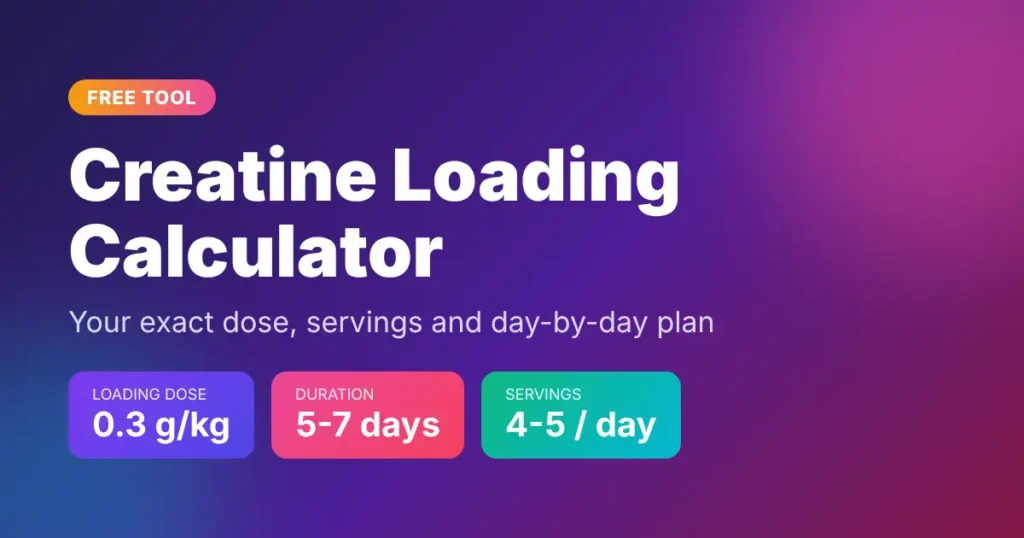
How much creatine should you take when loading? The standard creatine loading dose is about 0.3 grams per kilogram of body weight per day for 5–7 days. For most adults this works out to 20–25 grams per day, split into 4–5 smaller servings. After loading, you drop to a maintenance dose of 3–5 grams per day. Use the creatine loading calculator below to get your exact daily dose, serving size and day-by-day schedule in seconds.
Loading is the fastest way to fill your muscles with creatine, but it is also the part people get wrong most often. They take 20 g in one go, feel bloated, and quit. This guide shows you how to calculate your loading dose, how to split it, what a full week looks like, and whether you need to load at all.
How to Use the Creatine Loading Calculator
- Enter your body weight and choose kg or lb.
- Pick the loading length. 5, 6 or 7 days all work. The daily dose stays the same, only the total powder changes.
- Choose servings per day. 4 servings is standard. Choose 5 for smaller, gentler servings.
- Select your maintenance dose (3 g or 5 g) for after loading ends.
- Tap “Calculate My Loading Plan.” You get your daily dose, serving size, total powder needed and a day-by-day schedule.
Creatine Loading Formula
The math is simple:
- Daily loading dose: body weight in kg × 0.3
- Serving size: daily dose ÷ number of servings (keep each serving around 6 g or less)
- Total loading powder: daily dose × number of days
- Pounds to kg: divide pounds by 2.2
Worked example: an 80 kg (176 lb) person loads with 80 × 0.3 = 24 g per day. Split into 4 servings, that is 6 g each. Over 7 days the total is 168 g.
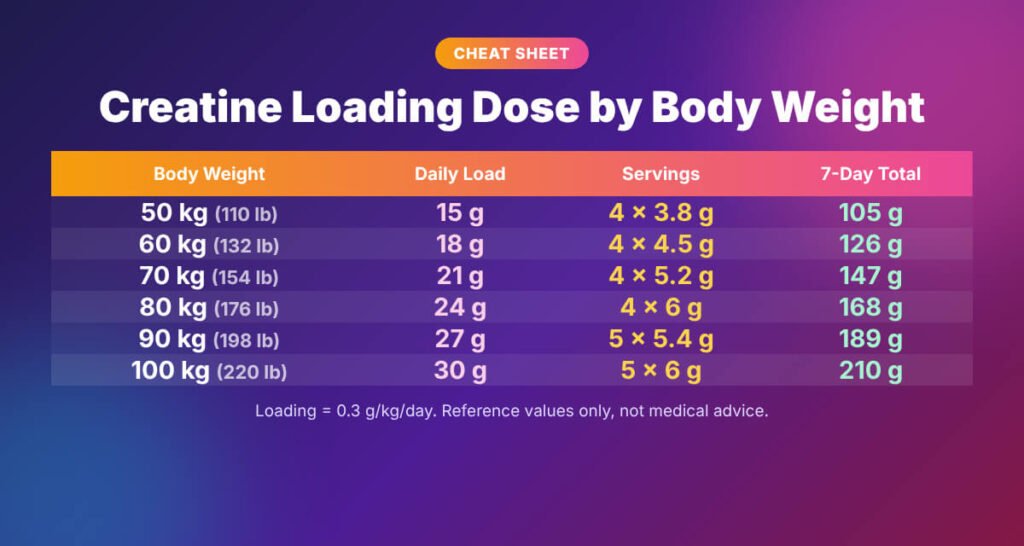
Creatine Loading Dose by Body Weight
| Body weight | Daily loading dose | Servings per day | 7-day total |
|---|---|---|---|
| 50 kg (110 lb) | 15 g | 4 × 3.8 g | 105 g |
| 60 kg (132 lb) | 18 g | 4 × 4.5 g | 126 g |
| 70 kg (154 lb) | 21 g | 4 × 5.2 g | 147 g |
| 80 kg (176 lb) | 24 g | 4 × 6 g | 168 g |
| 90 kg (198 lb) | 27 g | 5 × 5.4 g | 189 g |
| 100 kg (220 lb) | 30 g | 5 × 6 g | 210 g |
Sample 7-Day Creatine Loading Schedule
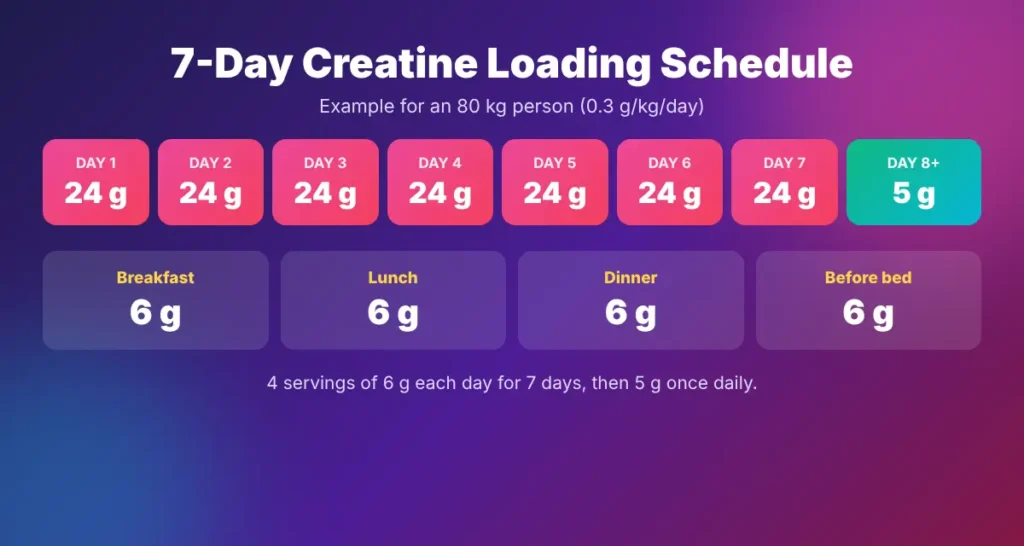
Here is what loading looks like for an 80 kg person:
- Days 1–7: 24 g per day, taken as 6 g at breakfast, lunch, dinner and before bed
- Day 8 onward: 5 g once daily, every day
Mix each serving in water, juice or a shake. Taking servings with a meal containing carbohydrates and protein can help muscle uptake and reduce stomach upset.
How Long Should You Load Creatine?
Five to seven days is the standard. Loading for longer does not add benefits because muscles are already saturated, and the extra creatine is simply excreted. After loading, you only need a small daily dose to maintain your stores.
Do You Actually Need to Load Creatine?
No. Loading is optional. A 2021 expert review on common creatine questions (Antonio et al., JISSN) concluded that a loading phase is not required to raise muscle creatine. Taking 3 g per day reaches the same saturation in about 28 days; loading just gets you there in about a week.
Load if you want faster results or have a competition or testing date coming soon.
Skip loading if you prefer a simple routine, have a sensitive stomach, or compete in a weight-class sport where early water gain could matter.
Creatine Loading Side Effects
Loading is generally well tolerated in healthy adults, but some effects are common:
- Water weight gain: The loading approach often results in a 1–3 kg rise in body mass, mostly water inside the muscles.
- Bloating or stomach upset: Large single doses (10 g or more) can cause this. Use more, smaller servings, take creatine with food, or skip loading.
- Kidneys: Studies in healthy adults have not shown kidney damage at recommended doses. People with kidney disease should consult a doctor first.
- Hair loss: Current human evidence does not show that creatine causes hair loss, though research is limited.
Creatine Loading for Women
Women can follow the same loading strategy as men, scaled to body weight. A 60 kg woman would load with about 18 g per day. Many women prefer skipping the load and taking 3 g daily, which reaches the same saturation within about four weeks.
What Happens After the Loading Phase?
Switch to a maintenance dose of 3–5 g per day and take it every day, including rest days. Larger athletes in heavy training may use 5–10 g per day. You do not need to cycle off creatine.
Related Tools
- Protein Intake Calculator
- Lean Body Mass Calculator
- One Rep Max Calculator
- Daily Calorie Calculator
- BMR & TDEE Calculator
- Creatine Dosage Calculator
Frequently Asked Questions About Creatine Loading
How much creatine should I take when loading?
About 0.3 g per kg of body weight per day (roughly 20–25 g for most adults) for 5–7 days, split into 4–5 servings.
How do I calculate my creatine loading dose?
Multiply your body weight in kg by 0.3. For example, 70 kg × 0.3 = 21 g per day. Use the calculator above for instant results in kg or lb.
How long should I load creatine?
5–7 days. Longer loading does not give extra benefit.
Do I have to take creatine in four servings?
Splitting is recommended because large single doses can upset your stomach. Four to five servings of about 5–6 g each is a common approach.
Is 20 g of creatine a day safe?
For healthy adults, studies show 20 g per day for 5–7 days is well tolerated. Check with a doctor if you have kidney problems or take medication.
Can I load creatine without bloating?
Use smaller, more frequent servings, take them with food, or skip loading and take 3–5 g daily.
Do I need to load creatine to see results?
No. Taking 3–5 g daily reaches the same muscle saturation in about 3–4 weeks.
How long does creatine take to work with loading?
Muscle stores fill in about 5–7 days of loading. Strength and performance changes show over several weeks of training.
How much weight will I gain from loading creatine?
Often 1–3 kg in the first week, mostly water stored inside muscles.
What do I do after the creatine loading phase?
Take 3–5 g once daily, every day.
Can I load creatine on an empty stomach?
It is better with food, as it can reduce stomach discomfort and may help uptake.
Should I load creatine before or after workouts?
Timing matters less than total daily intake. Spread servings through the day, including rest days.
Can women load creatine?
Yes, with the same method scaled to body weight, or skip loading and take 3 g daily.
Can teenagers load creatine?
Evidence in teens is limited, so they should speak to a doctor first.
Bottom Line
To load creatine, take about 0.3 g/kg per day for 5–7 days in 4–5 servings, then switch to 3–5 g daily. Use the creatine loading calculator above for your exact numbers. Loading is optional, so skip it if you prefer a gentler start.
References
- Kreider RB, et al. International Society of Sports Nutrition position stand: safety and efficacy of creatine supplementation in exercise, sport, and medicine. J Int Soc Sports Nutr. 2017;14:18. doi:10.1186/s12970-017-0173-z
- Antonio J, et al. Common questions and misconceptions about creatine supplementation: what does the scientific evidence really show? J Int Soc Sports Nutr. 2021;18:13. doi:10.1186/s12970-021-00412-w
Disclaimer
This article is for educational purposes only and is not medical advice. Consult a qualified healthcare professional before starting any supplement