
Note: This calculator is for general adults, not for pregnancy dieting. If you are pregnant, please follow your doctor’s advice.
BMI Calculator
Check your Body Mass Index with standard WHO and Asian cut-offs, find your healthy weight range, and add your waist for a more accurate picture, as recommended by the 2025 Lancet Commission.
BMI categories
| Category | BMI |
|---|
Weight at key BMI points for your height
| BMI | Weight for your height | Difference from you |
|---|
How to use this calculator
- Choose your sex and enter your age. This calculator is for adults aged 18 and over.
- Enter your weight in kg or lb. Weigh yourself in the morning, before eating, in light clothes.
- Enter your height in cm or feet and inches, measured without shoes.
- Pick the BMI scale. Choose Standard (WHO) for most people. Choose Asian descent if your family background is South or East Asian, because health risks start at a lower BMI for these groups.
- Optional but recommended: enter your waist measured at the level of the navel. BMI alone cannot show where fat is stored, so a waist reading gives a more reliable answer.
- Press Calculate my BMI.
- Read your BMI, category and healthy weight range, then check the combined view if you entered your waist.
- Use the result as a screening tool, not a diagnosis, and talk to your doctor if you are concerned.
BMI is a screening tool and not a diagnosis. It does not measure body fat, muscle or where fat is stored, and may be misleading for athletes, bodybuilders, older adults, pregnant women and people with a very short or tall frame. This calculator is for adults only. For children and teenagers, BMI must be compared with age and sex percentiles by a doctor.
BMI Calculator
Check Your Body Mass Index and Healthy Weight
Body Mass Index (BMI) is the most widely used quick check of whether your weight suits your height. Our BMI calculator gives your BMI and category using the international WHO scale, with optional lower cut-offs for people of Asian descent, shows your healthy weight range and how many kilograms to lose or gain, and, following the latest 2025 medical guidance, lets you add your waist so you get a more reliable answer than BMI alone.
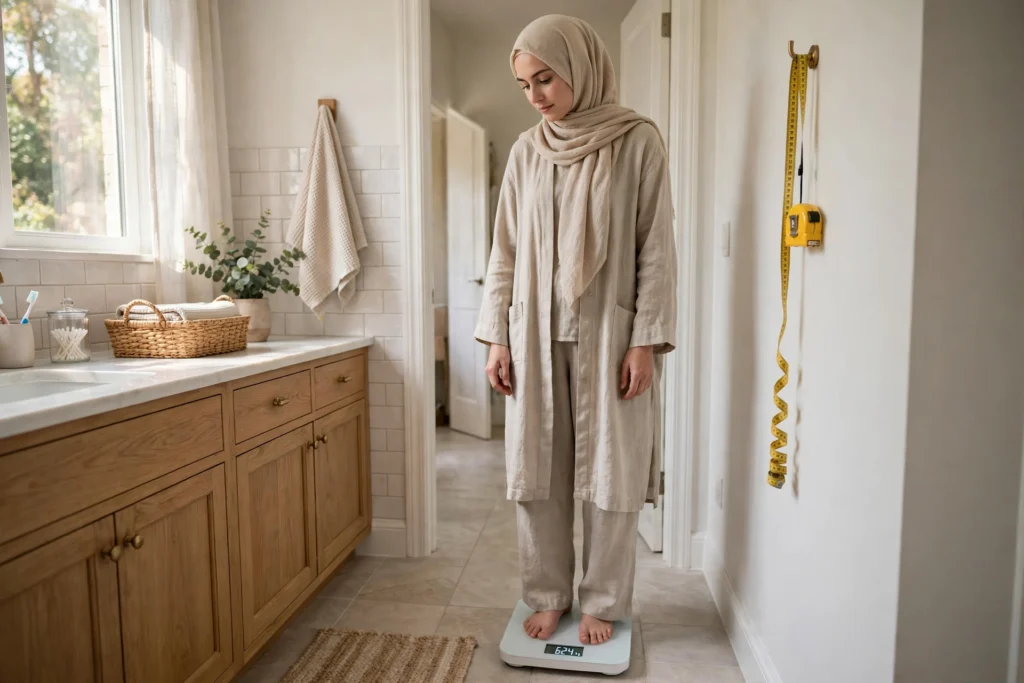
Quick Answer: What Is a Healthy BMI?
For adults, a healthy BMI on the standard WHO scale is 18.5 to 24.9. For people of Asian descent, many guidelines use a lower range of 18.5 to 22.9, because health risks rise at lower BMI levels.
| Category | Standard WHO scale (everyone) | Asian-descent scale |
|---|---|---|
| Underweight | Below 18.5 | Below 18.5 |
| Healthy weight | 18.5 to 24.9 | 18.5 to 22.9 |
| Overweight | 25.0 to 29.9 | 23.0 to 24.9 (at risk) |
| Obesity class I | 30.0 to 34.9 | 25.0 to 29.9 |
| Obesity class II | 35.0 to 39.9 | 30.0 and above |
| Obesity class III | 40.0 and above | n/a |
What Is BMI?
BMI is a number that compares your weight with your height. It was developed in the 1830s by the Belgian mathematician Adolphe Quetelet and named “body mass index” by physiologist Ancel Keys in 1972. It is popular because it is free, quick and strongly linked to health risks across large populations.
BMI Formula
Metric: BMI = weight (kg) ÷ height (m)²
Imperial: BMI = 703 × weight (lb) ÷ height (in)²
Worked Example
A person who weighs 70 kg and is 175 cm tall.
| Step | Calculation | Result |
|---|---|---|
| Height in metres | 175 ÷ 100 | 1.75 m |
| Height squared | 1.75 × 1.75 | 3.0625 |
| BMI | 70 ÷ 3.0625 | 22.9 |
| WHO category | 18.5 to 24.9 | Healthy |
| Asian category | 18.5 to 22.9 | Healthy (at the upper edge) |
Why Do People of Asian Descent Have Different BMI Cut-offs?
At the same BMI, people of South Asian descent tend to have more body fat, more fat around the abdomen and a higher risk of type 2 diabetes, high blood pressure and heart disease than people of European descent. After reviewing the evidence, a 2004 WHO expert consultation concluded that the international BMI categories should be kept, but added extra Asian action points at 23.0 (increased risk) and 27.5 (high risk). Many Asian health bodies, including Indian consensus guidelines, use 23 for overweight and 25 for obesity.
Our calculator uses the standard WHO scale by default and lets you switch to the Asian-descent scale. A BMI of 24 is “healthy” on the standard WHO scale but “overweight at risk” on the Asian-descent scale.
New in 2025: Why BMI Alone Is Not Enough
In January 2025, a Lancet Commission of international experts, endorsed by many medical organisations, proposed a new way to diagnose obesity. Its main points:
- BMI is a screening tool, not a diagnosis. It cannot tell fat from muscle, and it cannot show where fat is stored.
- Confirm excess body fat with another measure. A diagnosis should combine a high BMI with at least one body-measurement such as waist circumference, waist-to-height ratio or a direct body fat measurement.
- Waist limits quoted. A waist of 102 cm or more for men and 88 cm or more for women, or a waist-to-height ratio above 0.5, suggests excess fat. For people of South Asian descent, many guidelines use 90 cm for men and 80 cm for women.
- Two stages of obesity. The Commission separates “preclinical obesity” (excess fat but normal organ function) from “clinical obesity” (excess fat that is already affecting organs and daily life).
That is why this calculator has an optional waist field and a combined view:
| BMI | Waist | What it suggests |
|---|---|---|
| High | High | Excess body fat is very likely. Get a health check |
| Normal | High | Hidden belly fat, even at a normal weight |
| High | Normal | BMI may be overstating fat, for example in muscular people |
| Normal | Normal | Healthier range. Keep it up |
Add a deeper check with our Body Fat Calculator and Waist-to-Hip Ratio Calculator.
Healthy Weight Range by Height
| Height | Healthy weight (WHO, BMI 18.5 to 24.9) | Healthy weight (Asian, BMI 18.5 to 22.9) |
|---|---|---|
| 150 cm (4’11”) | 41.6 to 56.0 kg | 41.6 to 51.5 kg |
| 155 cm (5’1″) | 44.4 to 59.8 kg | 44.4 to 55.0 kg |
| 160 cm (5’3″) | 47.4 to 63.7 kg | 47.4 to 58.6 kg |
| 165 cm (5’5″) | 50.4 to 67.8 kg | 50.4 to 62.3 kg |
| 170 cm (5’7″) | 53.5 to 72.0 kg | 53.5 to 66.2 kg |
| 175 cm (5’9″) | 56.7 to 76.3 kg | 56.7 to 70.1 kg |
| 180 cm (5’11”) | 59.9 to 80.7 kg | 59.9 to 74.2 kg |
| 185 cm (6’1″) | 63.3 to 85.2 kg | 63.3 to 78.4 kg |
What Else Does the Calculator Show?
- Healthy weight range for your height and how much to lose or gain to reach it.
- BMI Prime: your BMI divided by the upper healthy limit (25 on the WHO scale, 23 on the Asian scale). Below 1.0 is healthy.
- “New BMI”: a formula proposed by Oxford mathematician Nick Trefethen in 2013: 1.3 × weight (kg) ÷ height (m)^2.5. It adjusts for the fact that tall people can look heavier on standard BMI and short people lighter. It is shown for comparison only and is not used in medical guidelines.
- Weight at key BMI points for your height, so you can set realistic milestones.
Is BMI Accurate? Limitations
BMI works well for the general population but can mislead individuals.
- Muscle: athletes and gym-goers can have a high BMI with low body fat.
- Age: older adults lose muscle and can have a “normal” BMI with high body fat. In adults over 65, a slightly higher BMI may even be protective.
- Fat distribution: BMI does not show belly fat, which is the riskiest type.
- Height: it can overestimate fat in very tall people and underestimate it in very short people.
- Pregnancy and breastfeeding: BMI is not valid.
- Ethnicity: the same BMI can mean different risks, which is why Asian cut-offs exist.
- Children and teenagers: they must be assessed using BMI-for-age percentile charts, not adult categories.
Health Risks at Different BMI Levels
Low BMI (below 18.5) can mean malnutrition, weak bones, anaemia, low immunity and fertility problems. Causes include illness, eating disorders, stress and not eating enough. See a doctor.
High BMI is linked to type 2 diabetes, high blood pressure, heart disease, stroke, fatty liver, sleep apnoea, joint pain, some cancers and fertility problems. Check your blood pressure with our Blood Pressure Checker.
How to Reach a Healthy BMI Safely
- Set a realistic goal. A loss of 5% to 10% of body weight improves blood pressure, blood sugar and cholesterol, even if your BMI is still above the healthy range.
- Use a moderate calorie deficit. About 250 to 500 kcal a day is sustainable. Use our BMR and TDEE Calculator and Calorie Deficit Calculator.
- Eat enough protein to protect muscle. Find your target with the Protein Intake Calculator, and split your food using the Macro Calculator.
- Plan your date. The Weight Loss Goal Date Calculator shows a realistic timeline.
- Move daily. Aim for 150 minutes of brisk activity a week plus strength training twice a week.
- Sleep 7 to 9 hours and manage stress.
- If you are underweight, eat more energy-dense, nutritious foods, add strength training and ask a doctor to rule out medical causes.
BMI and Weight Loss: A Realistic View
Moving from a BMI of 29 to 24 for a person of 170 cm means losing about 14 kg. At a steady 0.5 kg a week, that takes roughly 28 weeks, and more in practice because your calorie needs fall as you get lighter. Aim for progress you can maintain.
Common Mistakes
- Using adult BMI categories for children or teenagers
- Ignoring waist size and treating BMI as the full picture
- Using the standard scale when Asian-descent cut-offs apply to you, or the other way round
- Weighing yourself at different times of day and different clothing
- Chasing a BMI at the very bottom of the healthy range
- Assuming a “normal” BMI means no health risk
Related Calculators
- Body Fat Percentage Calculator
- Waist-to-Hip Ratio Calculator
- Calorie Deficit Calculator
- BMR and TDEE Calculator
- Protein Intake Calculator
- Macro Calculator
- Weight Loss Goal Date Calculator
- Blood Pressure Checker
Frequently Asked Questions
How do I calculate my BMI?
Divide your weight in kilograms by your height in metres squared. For example, 70 kg at 1.75 m is 70 ÷ 3.06 = 22.9.
What is a healthy BMI?
18.5 to 24.9 for most adults on the standard WHO scale. People of Asian descent are often advised to stay within 18.5 to 22.9.
What is a good BMI for women?
The same ranges apply to men and women. Women naturally carry more body fat at the same BMI.
Is a BMI of 25 overweight?
On the standard WHO scale, yes, 25 is the start of the overweight range. On the Asian-descent scale, overweight begins at 23.
Is a BMI of 23 normal?
On the standard WHO scale, yes: 18.5 to 24.9 is healthy. On the Asian-descent scale, 23.0 to 24.9 is overweight (at risk), so check your waist as well.
What BMI is considered obese?
30 or above on the standard WHO scale. Many Asian guidelines use 25 or above for people of Asian descent.
Is BMI accurate for athletes?
Not always. Muscle weighs more than fat, so athletes can have a high BMI with low body fat. Use body fat percentage and waist as well.
What is a healthy BMI for a 60-year-old?
The standard range applies, but doctors often accept a slightly higher BMI in older adults. Losing weight unintentionally is a bigger concern.
What is the difference between BMI and body fat percentage?
BMI compares weight with height. Body fat percentage measures how much of your weight is fat. Try our Body Fat Calculator.
Why did the Lancet say BMI is not enough?
BMI cannot show body fat or where it is stored. The 2025 Lancet Commission recommends combining BMI with a waist measure or direct fat measurement to diagnose obesity.
Can I use this BMI calculator for my child?
No. Children and teenagers need BMI-for-age percentile charts, which a paediatrician can use.
How often should I check my BMI?
Every 1 to 3 months is plenty. Use your waist measurement alongside it.
Does BMI change with age?
The formula does not, but body composition does. Older adults can have a normal BMI and still have low muscle and higher fat.
Final Thoughts
BMI is a useful first step, not the final answer. Use the Asian scale if it applies to you, add your waist, check blood pressure and body fat, and set goals you can sustain. If your results worry you, speak to a doctor.
Medical disclaimer
: This calculator and article are for education only and are not medical advice or a diagnosis. Speak to a doctor or registered dietitian before changing your diet or exercise plan.