
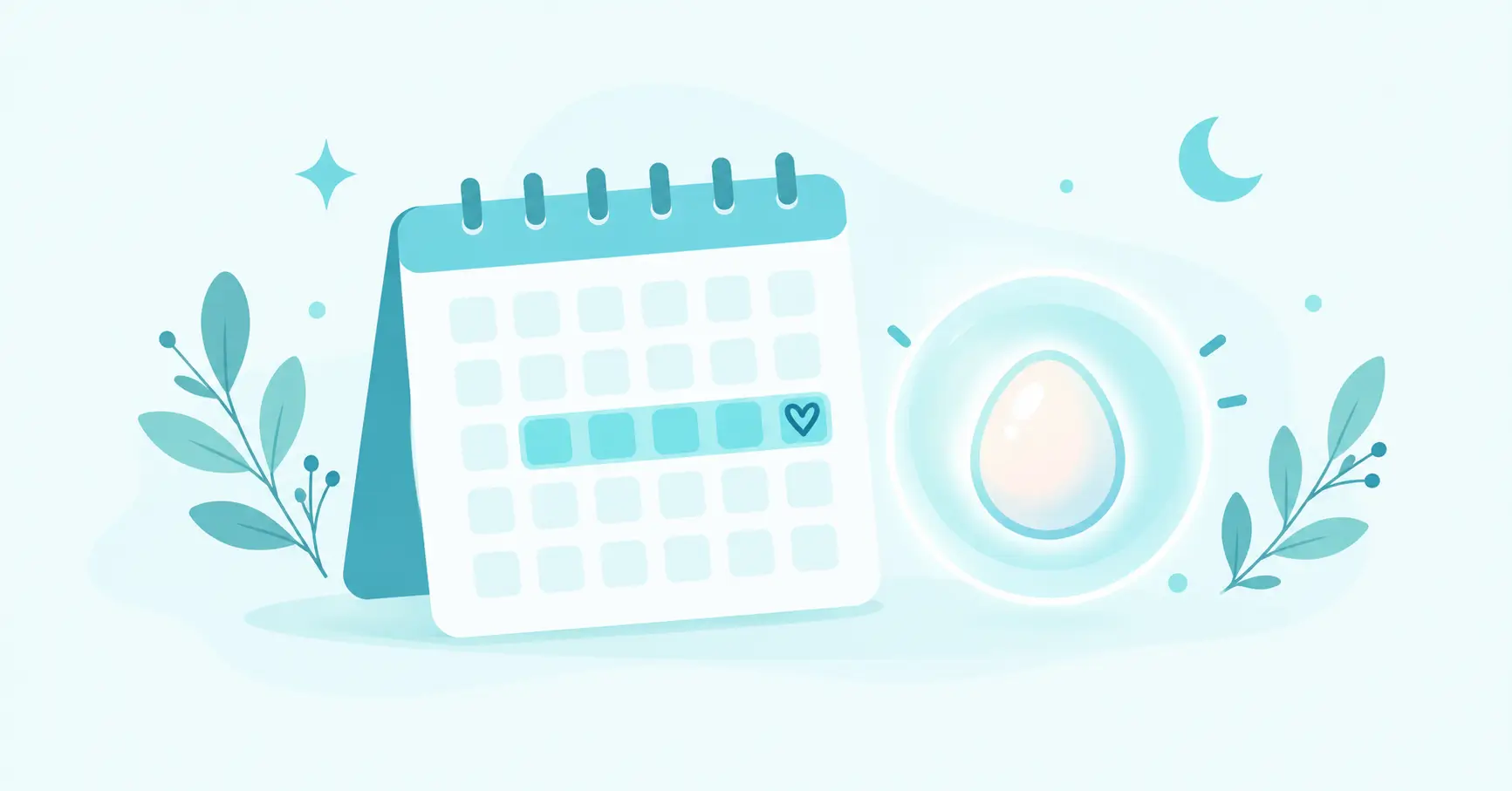

To predict ovulation with irregular cycles, do not look for one magic day. Work out a fertile-window range instead, and then confirm it with body signs and simple tests.
With regular cycles, ovulation often falls near the middle. With irregular cycles or PCOS, that middle keeps moving. So the honest answer is a window of possible days, not a single date. This guide shows how to build that window and how to narrow it down. It is general information, not medical advice.
Why Irregular Cycles Make Prediction Hard
In most cycles, the time after ovulation is fairly steady. It is usually about 12 to 14 days. However, the time before ovulation can change a lot.
That first part is where the variation hides. Stress, illness, travel, weight change and hormone conditions can all delay the egg’s release. PCOS can also delay it, or sometimes stop it for that cycle.
Because of this, an app that simply counts forward from your period can miss badly. It assumes an average cycle. Your body may not follow that average this month. In addition, a bleed does not always prove that an egg was released first. Some cycles are anovulatory, which means no egg is released at all.
The Range Method: Predict Ovulation With Irregular Cycles as a Window
The safest calendar method uses your shortest and longest cycles. First, look back over your last six cycles. Note the shortest one and the longest one.
Then use these two sums:
- First fertile day = your shortest cycle minus 18
- Last fertile day = your longest cycle minus 11
These are cycle days. Day 1 is the first day of your period.
The result is often wide. That is not a mistake. It is the truthful answer when cycles vary. After that, you use other signs inside the window to find the days that matter most.
Worked Example: Cycles That Vary From 30 to 45 Days
Imagine your last six cycles ranged from 30 to 45 days. Your last period started on 1 March 2026, which is day 1.
| Estimate | Sum | Cycle day | Date in this example |
|---|---|---|---|
| First fertile day, from the shortest cycle | 30 − 18 | Day 12 | 12 March 2026 |
| Likely ovulation if this is a 30-day cycle | 30 − 14 | Day 16 | 16 March 2026 |
| Likely ovulation if this is a 45-day cycle | 45 − 14 | Day 31 | 31 March 2026 |
| Last fertile day, from the longest cycle | 45 − 11 | Day 34 | 3 April 2026 |
So the shortest-cycle estimate points to ovulation near 16 March. In contrast, the longest-cycle estimate points to 31 March. Meanwhile, the full fertile-window range runs from 12 March to 3 April 2026.
That range looks frustrating. Still, it protects you from the biggest mistake, which is testing or trying on one guessed day and missing the real one. If no pregnancy happens, this same example also shows why timing is hard: a 30-day cycle would end with a next period on 31 March 2026, while a 45-day cycle would not end until 15 April 2026.
How to Track Ovulation With Irregular Cycles, Step by Step
- First, write down the first day of each period for at least three cycles. Six cycles give a clearer pattern.
- Next, find your shortest and longest cycle from those records.
- Then work out your fertile-window range with the minus 18 and minus 11 sums above.
- After that, start checking cervical mucus a few days before the range begins. Look for mucus that turns clear, slippery and stretchy, like raw egg white.
- Use ovulation predictor kits inside the range, not on one fixed day. Many women test once a day at first, and then twice a day when mucus looks fertile.
- Take your basal body temperature every morning before getting up. A clear rise that stays up usually confirms that ovulation has already happened.
- Finally, mark which signs matched. Over two or three cycles, your own pattern will teach you more than any average.
Do not stop at the calendar result. The range tells you when to watch. The mucus, test kits and temperature tell you what your body is actually doing.
Method Comparison: What Each Tool Can and Cannot Tell You
| Method | What it tells you | Main strength | Main limit |
|---|---|---|---|
| Calendar or app estimate | A guessed fertile window | Easy starting point | Weak when cycles vary, and weakest with PCOS |
| Cervical mucus checks | Ovulation may be near | Free, and it changes before ovulation | Takes practice, and infections or semen can confuse the signs |
| Ovulation predictor kits (OPKs) | An LH surge, usually 24 to 36 hours before ovulation | Helpful for timing within the window | Raised LH in some women with PCOS can cause false or repeated positives |
| Basal body temperature (BBT) | Ovulation has likely already happened | Good for confirming a pattern over time | It does not warn you early enough for this cycle’s timing |
| Clinic ultrasound and blood tests | Follicle growth, and progesterone proof after ovulation | Most reliable option | Costs money and needs clinic visits |
In short, no single home method is perfect. The strongest home approach is a combination: range first, mucus and OPKs to narrow it, and BBT to confirm it afterwards.
PCOS: Extra Care With Ovulation Prediction
PCOS deserves its own warning. With PCOS, the ovaries may prepare more than one follicle, and LH can run higher than usual. As a result, an ovulation kit can show positive or near-positive results on days when no egg follows.
Also, your body may gear up to ovulate, pause, and then try again later in the same cycle. That is why one early positive test can mislead you. Keep testing through the fertile signs, and use BBT or a clinic progesterone test when you need firmer proof.
If your charts show no temperature shift for repeated cycles, that matters. It may mean ovulation is not happening often. A doctor can check this with timed blood tests and ultrasound follicle tracking, which are far more reliable than any app. Please do not start medicines or supplements to force ovulation based on a chart alone. That decision belongs with your doctor, who knows your reports.
When to See a Doctor
Book an appointment sooner rather than later if any of these fit you:
- You have been trying for 12 months and you are under 35.
- You have been trying for 6 months and you are 35 or older.
- Your cycles are shorter than 21 days or longer than 35 days.
- You miss periods, or you go two to three months without one.
- Your temperature charts repeatedly show no sign of ovulation.
- You have PCOS and your cycles are very long or absent.
Early help is not a failure. It simply replaces guessing with testing. For many couples, that saves months of stress.
Frequently Asked Questions
Can an ovulation calculator work with irregular cycles?
It can give you a starting range, but it cannot give a reliable single day. Our Ovulation Calculator is most useful when you enter your shortest and longest recent cycles and treat the answer as a window. Then confirm the window with mucus signs, test kits or temperature.
Can I ovulate if my periods are irregular?
Yes, many women with irregular periods do ovulate, just not on a predictable day. However, some cycles release no egg at all. A temperature rise that stays up, or a progesterone blood test about seven days after suspected ovulation, gives better proof than the period date alone.
Why does my ovulation test look positive for many days with PCOS?
Some women with PCOS have higher LH levels through the cycle. The kit may react to that background level, not only to a true surge. For that reason, compare the test with mucus changes, keep testing, and confirm with BBT or clinic testing when the result really matters.
When should I take a pregnancy test if my cycles are irregular?
Wait until your longest usual cycle has passed, or test about 14 days after confirmed ovulation. Testing by your shortest cycle often gives a false negative, simply because it is too early. If your period still does not arrive and tests stay negative, see a doctor.
Does basal body temperature predict ovulation before it happens?
No. BBT mainly confirms ovulation after it has happened, because the temperature rises afterwards. Its real value is learning your pattern over several cycles, and proving whether ovulation seems to be occurring at all.
Related Tools
- Ovulation Calculator
- Safe Period Calculator
- Pregnancy Test Date Calculator
- Due Date Calculator
- hCG Calculator
Sources
American College of Obstetricians and Gynecologists (ACOG), patient and committee guidance on ovulation, fertility awareness and evaluating infertility, including the advice to seek assessment after 12 months of trying under age 35, and after 6 months at age 35 or older. American Society for Reproductive Medicine (ASRM), committee guidance on optimising natural fertility and on PCOS, covering cycle tracking, ovulation predictor kits, basal body temperature and the limits of calendar prediction when cycles are irregular.
1 thought on “How Do I Predict Ovulation With Irregular Cycles or PCOS?”
Comments are closed.