
Please note: This corrected age calculator is for general information only and is not medical advice. Every baby is different. Always follow your pediatrician’s or neonatologist’s guidance about your baby’s growth, development and care.
👶 Corrected Age Calculator
Find your premature baby's corrected (adjusted) age in weeks and months.
Your Baby's Age Results
How to Use the Corrected Age Calculator
Enter your baby's date of birth (the day your baby was actually born).
Choose the date to calculate for. It is set to today. Change it to see the age on another day.
Enter gestational age at birth in weeks, and days if you know them. For example, 34 weeks and 2 days.
Tap Calculate Corrected Age. You will see the corrected age, actual age, how early your baby was born and the original due date.
Corrected Age Calculator: How to Calculate Your Premature Baby’s Adjusted Age

How do you calculate your premature baby’s corrected age? Subtract the number of weeks your baby was born early from their actual age. Corrected age (also called adjusted age) is the age your baby would be if they had been born on their due date. For example, a baby who is 16 weeks old and was born 6 weeks early has a corrected age of 10 weeks. Enter your baby’s birth date and gestational age in the corrected age calculator below to get the exact result in months, weeks and days.
If your baby arrived early, you will hear two ages: the age since birth and the corrected age. It can be confusing, and many parents worry when their baby seems “behind” other babies of the same age. This guide explains how corrected age works, when to use it, when to stop, and answers the questions parents search for most.
How to Use the Corrected Age Calculator
- Enter your baby’s date of birth, the day your baby was actually born.
- Choose the date to calculate for. It is set to today, but you can change it.
- Enter gestational age at birth in weeks, and days if you know them (for example, 34 weeks and 2 days).
- Tap “Calculate Corrected Age.” You get the corrected age, actual age, how early your baby was born and the original due date.
Corrected Age Calculator for Premature Babies: What It Calculates
This corrected age calculator for premature babies works out your baby’s age as if they had been born on their original due date. You enter three things: your baby’s date of birth, the date you want the age for, and gestational age at birth (weeks, and days if you know them). The calculator then shows:
- Corrected age in months, weeks and days
- Actual (chronological) age since birth
- How early your baby was born, counted from 40 weeks
- The original due date
It is made for parents and caregivers of babies born before 37 weeks. If your baby was born at 37 weeks or later, the calculator tells you no correction is needed. If your baby has not reached the due date yet, it shows how long is left until then. Use the result when you compare your baby’s milestones and growth with typical ranges, and share it with your pediatrician at check-ups.
What Is Corrected Age (Adjusted Age)?
Corrected age is your baby’s age counted from the original due date instead of the birth date. Your baby’s actual age since birth is called chronological age. A baby born early has had less time to grow and develop before birth, so comparing them with babies born at full term using actual age can make them look behind when they are not.
Corrected age is used for babies born before 37 weeks. Full term is counted as 40 weeks, so the “weeks early” figure is 40 minus your baby’s gestational age at birth.
How to Calculate Corrected Age: The Formula
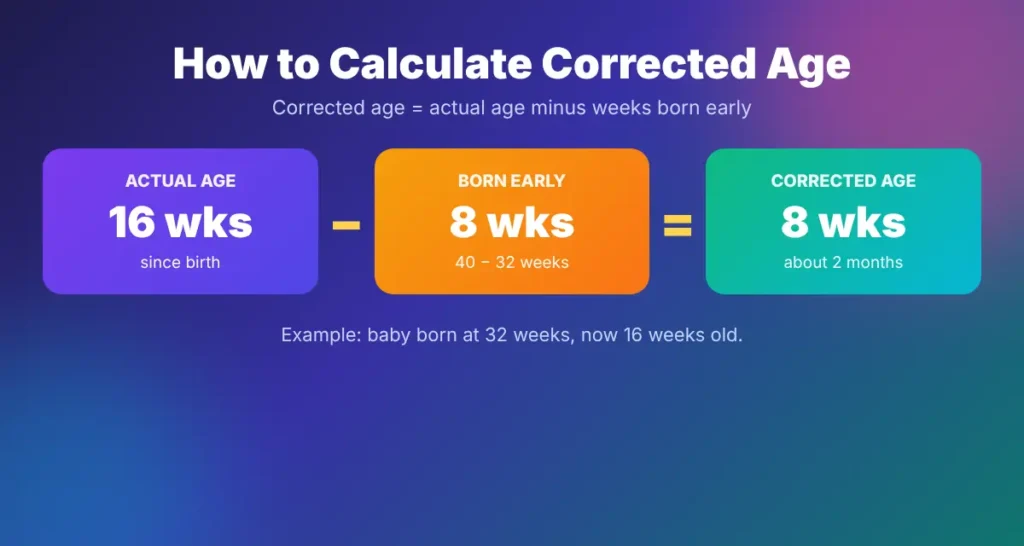
Corrected age = actual age − weeks born early
Steps:
- Work out how many weeks early your baby was born: 40 weeks minus gestational age at birth.
- Find your baby’s actual age since birth.
- Subtract the weeks early from the actual age.
Example: a baby born at 32 weeks is 8 weeks early. At 16 weeks old, the corrected age is 16 − 8 = 8 weeks, which is about 2 months.
You can also work in days: corrected age in days = actual age in days + gestational age in days − 280.
What Is the Adjusted Age for a Baby Born 6 Weeks Early?
A baby born 6 weeks early was born at about 34 weeks of pregnancy. Subtract 6 weeks from the actual age:
| Actual age | Corrected age (born 6 weeks early) |
|---|---|
| 8 weeks | 2 weeks |
| 3 months (about 13 weeks) | about 7 weeks (1.5 months) |
| 4 months (about 17 weeks) | about 11 weeks (2.5 months) |
| 6 months (26 weeks) | 20 weeks (about 4.5 months) |
| 9 months (39 weeks) | 33 weeks (about 7.5 months) |
| 12 months (52 weeks) | 46 weeks (about 10.5 months) |
So at 6 months old, a baby born 6 weeks early should be compared with a baby around 4.5 months old.
Corrected Age Chart: Weeks Born Early
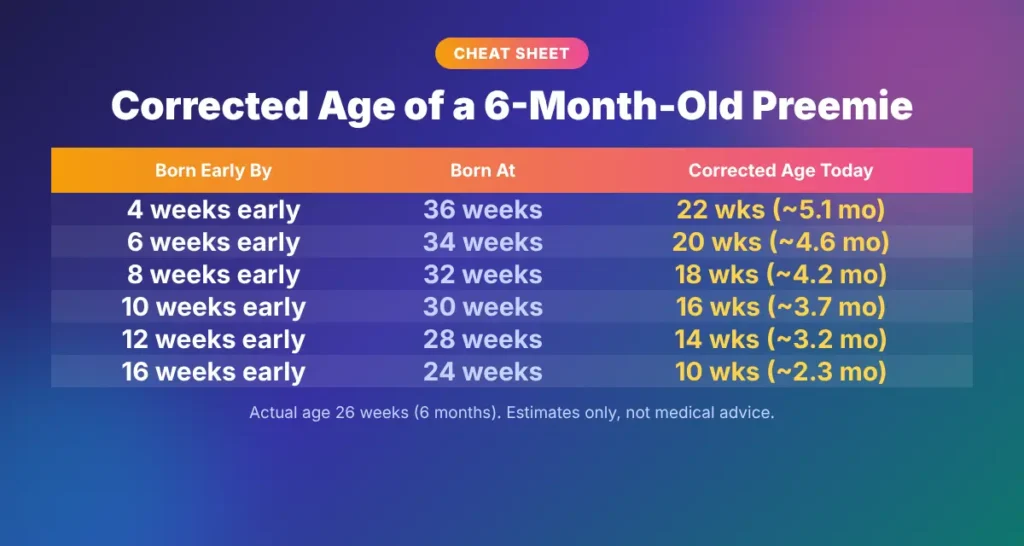
Here is the corrected age of a 6-month-old (26 weeks) baby based on how early they were born:
| Born early by | Born at | Corrected age today |
|---|---|---|
| 4 weeks | 36 weeks | 22 weeks (about 5 months) |
| 6 weeks | 34 weeks | 20 weeks (about 4.5 months) |
| 8 weeks | 32 weeks | 18 weeks (about 4 months) |
| 10 weeks | 30 weeks | 16 weeks (about 3.5 months) |
| 12 weeks | 28 weeks | 14 weeks (about 3 months) |
| 16 weeks | 24 weeks | 10 weeks (about 2 months) |
What If My Baby Has Not Reached the Due Date Yet?
If your baby is still younger than their original due date, the usual subtraction gives a negative number. In this case, doctors use corrected gestational age (also called postmenstrual age): gestational age at birth plus the time since birth. For example, a baby born at 30 weeks who is now 4 weeks old has a corrected gestational age of 34 weeks. The calculator shows how many weeks are left until the due date in this situation.
Should I Use Corrected Age for Baby Milestones and Growth Charts?
Yes. Corrected age is the fairer way to judge both:
- Milestones: Smiling, rolling, sitting, crawling and talking should be compared with the corrected age. A baby who is 6 months old but 4 months corrected should be compared with 4-month-olds.
- Growth charts: For premature babies, weight, length and head size are generally plotted using corrected age on WHO or CDC growth charts, so growth is not wrongly judged as slow.
If you are worried, talk to your pediatrician. Early follow-up helps babies who need extra support.
What Is NOT Based on Corrected Age?
Vaccines are given by actual age from the birth date, not corrected age. A preterm baby still receives vaccines on the regular schedule, because early protection matters. Your doctor will advise on the exact schedule, and on feeding and starting solids, which depend on your baby’s readiness and your doctor’s advice.
How Long Should I Use Corrected Age for My Preemie?
Most guidance says to use corrected age until your baby is about 2 years (24 months) old. After that, the gap of a few weeks matters much less and actual age is used. Some sources and clinics keep correcting a little longer, up to about 3 years, especially for babies born very early (before 28 weeks) or very small (under 1,000 g). Because advice varies, follow what your baby’s doctor recommends.
Is Corrected Age Used for All Premature Babies?
It is used for babies born before 37 weeks. Babies born at 37 weeks or later are considered term, so corrected age equals actual age. Babies born only a few weeks early often catch up earlier, while babies born very early may need longer.
What If I Don’t Know My Baby’s Gestational Age?
Check your hospital discharge papers, your baby’s health record, or ask your doctor or NICU team. They record gestational age at birth. If you only know the due date, you can work out the weeks early by counting from the birth date to the due date.
Related tools
- Plan feeding changes with the Baby Feeding Reminder
- Still choosing a name? Browse our Baby Name Generator.
- Planning the costs of the first year? The Baby Budget Calculator can help
- Hospital Bag Checklist
Frequently Asked Questions About Corrected Age
How do I calculate my premature baby’s corrected age?
Subtract the number of weeks your baby was born early from their actual age. To find the weeks early, take 40 weeks and subtract your baby’s gestational age at birth. For example, a baby born at 34 weeks was born 6 weeks early. If that baby is now 16 weeks old, the corrected age is 16 − 6 = 10 weeks. To get months, divide the weeks by about 4.3. You can also enter the dates in the calculator above for an exact answer in months, weeks and days.
What is adjusted age for a baby born 6 weeks early?
A baby born 6 weeks early was born at about 34 weeks of pregnancy. Their adjusted age is their actual age minus 6 weeks. At 3 months old (about 13 weeks), the adjusted age is about 7 weeks. At 6 months old (26 weeks), it is 20 weeks, or about 4.5 months. This means you should compare this baby with babies who are about 4.5 months old, not 6 months.
What is the corrected age calculator for premature babies?
An online tool that uses your baby’s date of birth and gestational age at birth to calculate their corrected age, actual age and original due date. It saves you from doing the weeks-and-months math by hand, especially when the birth date and due date fall in different months. It is for general information, so always check your baby’s development with their doctor.
How long should I use corrected age for my preemie?
Most guidance recommends using corrected age until your baby is about 2 years (24 months) old. After that, a difference of a few weeks matters much less, and actual age is used. Some sources keep correcting a little longer, up to about 3 years, for babies born very early (before 28 weeks) or very small (under 1,000 g). Advice can differ between clinics, so follow what your baby’s doctor recommends.
Should I use corrected age for baby milestones and growth charts?
Yes. Corrected age gives a fairer comparison for both. For milestones such as smiling, rolling, sitting, crawling and talking, compare your baby with the corrected age, not the birth date. For growth charts, weight, length and head size are generally plotted using corrected age on WHO or CDC charts, usually until about 2 years. The exception is vaccines, which follow actual age from the birth date. If your baby is not reaching milestones for their corrected age, talk to your pediatrician early.
What is the difference between corrected age and chronological age?
Chronological age is the time since birth. Corrected age is the time since the original due date.
Do I use corrected age for vaccines?
No. Vaccines follow actual age from the birth date.
Is corrected age the same as adjusted age?
Yes. The two terms mean the same thing.
At what age do premature babies catch up?
Many catch up in growth and development by about age 2, but timing differs from baby to baby.
How do I calculate corrected age in months?
Subtract the weeks born early from the actual age in weeks, then divide by about 4.3 to get months. Or use the calculator for exact months, weeks and days.
Does a baby born at 37 weeks need corrected age?
No. Babies born at 37 weeks or later are considered term.
When should I talk to a doctor about development?
If your baby is not reaching milestones for their corrected age, or you are worried, speak to your pediatrician. Do not wait.
Bottom Line
To find your premature baby’s corrected age, subtract the weeks born early from their actual age. Use corrected age for milestones and growth charts until about 2 years, but use actual age for vaccines. Enter your details in the corrected age calculator above for an exact answer, and talk to your baby’s doctor about any concerns.
References
- Pregnancy, Birth and Baby (Australian Government). Corrected age for premature babies. pregnancybirthbaby.org.au
- Pathways.org. Corrected Age for Preemies: What It Is and How to Calculate It. pathways.org
- University of Washington, Maternal and Child Health Bureau. Growth charts for premature infants (corrected age). depts.washington.edu/growth
- Washington State DCYF. Age Correction in Evaluation and Assessment of Premature Infants. dcyf.wa.gov
Disclaimer
This article is for educational purposes only and is not medical advice. Always consult your baby’s doctor