
Bulking Calculator
Daily bulking calories, macros & weekly weight gain
Daily macro targets
Estimates use the Mifflin-St Jeor equation and the rule of thumb that about 7,700 kcal equals 1 kg of body weight. Weigh yourself weekly and adjust by 100-200 kcal if your progress is faster or slower than planned. Not medical advice.
Bulking Calculator: Calories & Macros to Gain Muscle
To bulk, eat about 250 to 500 calories above your maintenance calories (TDEE) every day while lifting weights. That surplus is enough to support muscle growth without adding too much fat, and it usually means gaining roughly 0.25 to 0.5 kg (0.5 to 1 lb) per week. Our free bulking calculator works out your maintenance calories, your daily bulking calories, your protein, carb and fat targets, your expected weekly and monthly weight gain, and how many weeks it will take to reach your goal weight.
How to use the bulking calculator
- Choose metric (kg and cm) or imperial (lb and feet/inches).
- Select your sex and enter your age, height and current weight.
- Pick your activity level. Be honest: most people overestimate how active they are.
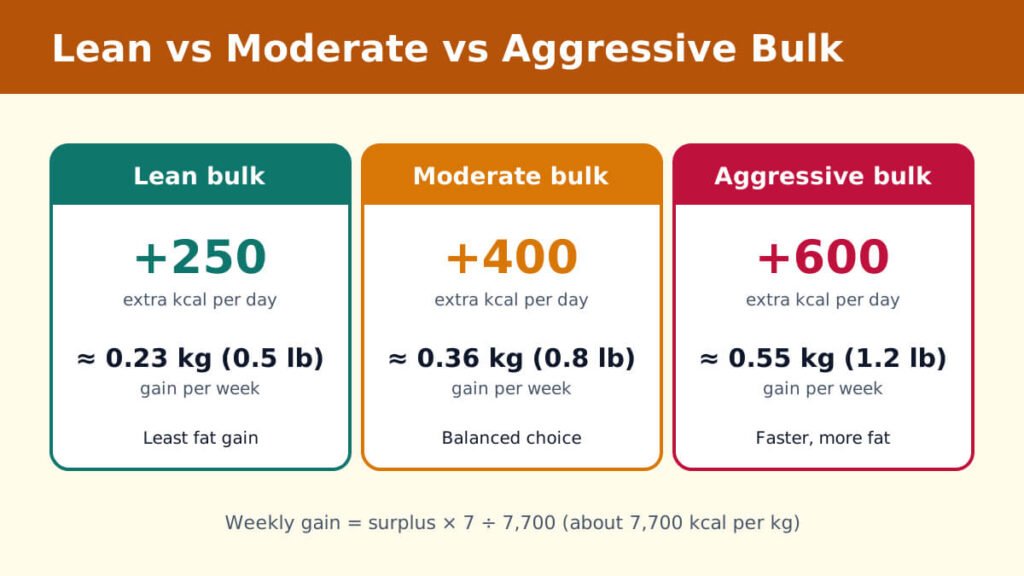
- Choose a bulking pace: lean (+250 kcal), moderate (+400 kcal) or aggressive (+600 kcal).
- Optionally enter a goal weight to see how long your bulk will take.
- Press the button to see your daily calories, weekly gain, macro targets and timeline.
If you are not sure about your maintenance calories, check them first with our BMR & TDEE Calculator.
Not sure which activity level fits you? Count your daily steps and convert them with our [Steps to Miles Calculator], and see how much you really burn with the Calories Burned Calculator.
How the bulking calculator works
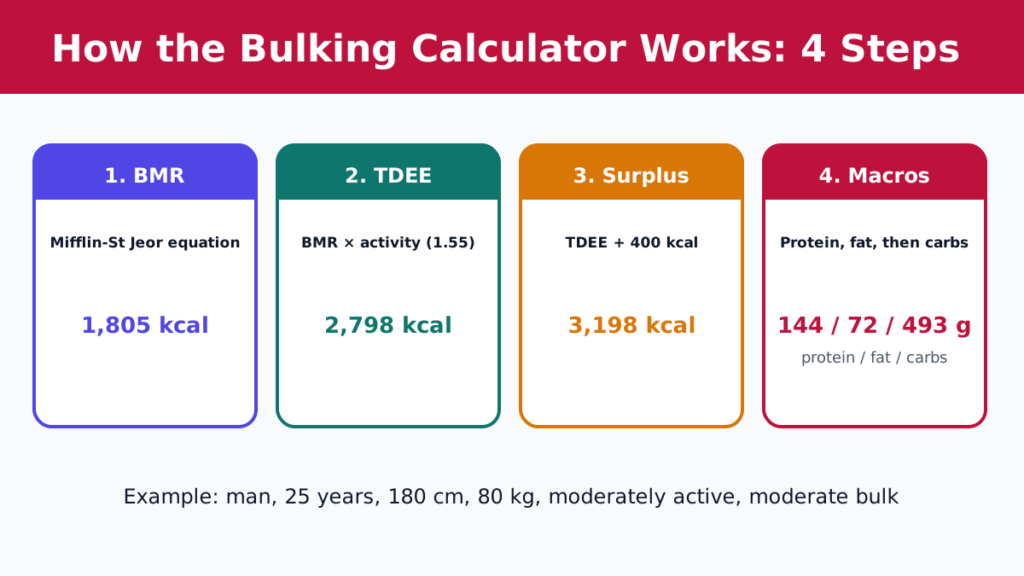
The calculator follows four simple steps.
Step 1: Basal metabolic rate (BMR)
BMR is the energy your body burns at rest. The calculator uses the Mifflin-St Jeor equation, which is one of the most widely used formulas:
- Men: BMR = (10 × weight in kg) + (6.25 × height in cm) − (5 × age) + 5
- Women: BMR = (10 × weight in kg) + (6.25 × height in cm) − (5 × age) − 161
Step 2: Maintenance calories (TDEE)
TDEE is your BMR multiplied by an activity factor:
| Activity level | Multiplier |
|---|---|
| Sedentary (little exercise) | 1.2 |
| Light (1 to 3 days per week) | 1.375 |
| Moderate (3 to 5 days per week) | 1.55 |
| Very active (6 to 7 days per week) | 1.725 |
| Extra active (hard training plus a physical job) | 1.9 |
Step 3: Add your calorie surplus
Bulking calories = TDEE + surplus. A surplus is the extra energy your body can use to build new tissue. Weekly weight gain is estimated with the common rule of thumb that about 7,700 kcal equals 1 kg of body weight:
Weekly gain (kg) = surplus × 7 ÷ 7,700
Step 4: Set your macros
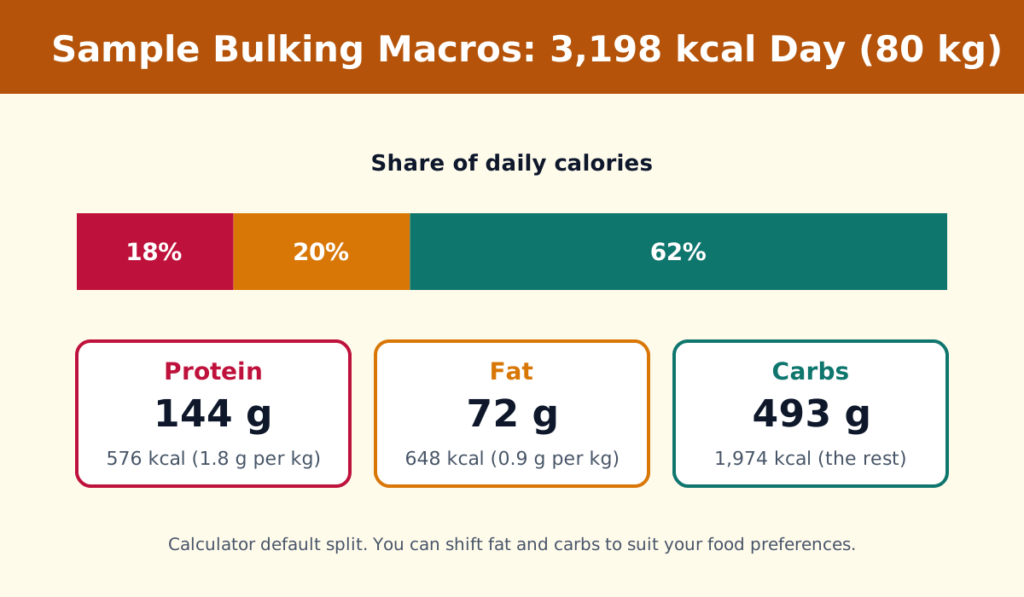
Protein is set at 1.8 g per kg of body weight, fat at 0.9 g per kg, and carbohydrates fill the rest of your calories. Protein and carbs provide 4 kcal per gram, and fat provides 9 kcal per gram.
These are estimates. Your real needs depend on genetics, daily movement and training, so treat the result as a starting point and adjust using your own weekly weigh-ins.
You can double-check your calorie target against the Daily Calorie Calculator and plan your food split with the Macro Calculator. To see how your starting weight compares with general guidance, check your BMI Calculator and Ideal Body Weight Calculator results first.
Worked examples
Example 1: moderately active man. 25 years old, 180 cm, 80 kg, training 3 to 5 days per week. BMR = 800 + 1,125 − 125 + 5 = 1,805 kcal. TDEE = 1,805 × 1.55 = 2,798 kcal. On a moderate bulk (+400) he should eat 3,198 kcal, which means 144 g protein, 72 g fat and about 493 g carbs. Expected gain: about 0.36 kg per week. If his goal is 85 kg, he needs about 14 weeks.
Example 2: lightly active woman. 24 years old, 165 cm, 55 kg, training 1 to 3 days per week. BMR = 550 + 1,031 − 120 − 161 = 1,300 kcal. TDEE = 1,300 × 1.375 = 1,788 kcal. On a lean bulk (+250) she should eat 2,038 kcal, with about 99 g protein, 50 g fat and 299 g carbs. Expected gain: about 0.23 kg per week.
Example 3: skinny beginner. 20 years old, 178 cm, 65 kg, light activity. BMR = 650 + 1,113 − 100 + 5 = 1,668 kcal. TDEE = 1,668 × 1.375 = 2,293 kcal. On a moderate bulk (+400) he should eat 2,693 kcal, with 117 g protein, about 59 g fat and 425 g carbs.
Knowing your starting body fat helps you decide how aggressively to bulk. Measure it with the Body Fat Percentage Calculator, or use the Army Body Fat Calculator if you only have a tape measure.
How many calories should you eat to bulk?
Most evidence-based guides land on a surplus of roughly 200 to 500 kcal per day. A bigger surplus does not speed up muscle growth much. In controlled studies, larger surpluses mostly added extra fat.
| Style | Daily surplus | Typical weekly gain | Best for |
|---|---|---|---|
| Lean bulk | +200 to +300 kcal | 0.2 to 0.3 kg (0.4 to 0.6 lb) | Intermediate and advanced lifters, or anyone who wants minimal fat gain |
| Moderate bulk | +300 to +500 kcal | 0.3 to 0.45 kg (0.6 to 1 lb) | Most beginners and intermediates |
| Aggressive bulk | +500 to +750 kcal | 0.45 to 0.7 kg (1 to 1.5 lb) | Underweight people and hard gainers |
| Dirty bulk | +1,000 kcal or more | 0.9 kg (2 lb) or more | Not recommended for most people because much of the gain is fat |
Quick reference: calories needed for each rate of gain
| Target weekly gain | Extra calories per day |
|---|---|
| 0.25 kg (0.5 lb) | about 275 kcal |
| 0.5 kg (1 lb) | about 550 kcal |
| 0.75 kg (1.65 lb) | about 825 kcal |
| 1 kg (2.2 lb) | about 1,100 kcal |
How fast should you gain weight on a bulk?
The more experience you have, the slower your muscle gain becomes, so your rate of weight gain should drop as you progress. A common guide is the percentage of body weight gained per week:
| Training experience | Suggested gain per week | Example at 80 kg |
|---|---|---|
| Beginner (under 1 year) | 0.25% to 0.5% | 0.2 to 0.4 kg |
| Intermediate (1 to 3 years) | about 0.25% | about 0.2 kg |
| Advanced (3+ years) | 0.1% to 0.15% | 0.08 to 0.12 kg |
Beginners can often afford to gain a little faster. Advanced lifters have less room to grow, so extra calories turn into fat more quickly. Track your weekly average body weight, not a single morning reading, because water, salt and food volume move the scale by a kilogram or more.
Water retention can change your weight by a kilogram or more in a day, so stay hydrated and consistent. Use the Water Intake Calculator to find your daily target, and track your waist with the Waist-to-Hip Ratio Calculator to see where new weight is going.
Macros for bulking
Protein
Protein supplies the building blocks for muscle. Research reviews suggest that muscle-building benefits level off at around 1.6 g per kg of body weight per day for most people, and many lifters aim a bit higher, up to about 2.2 g per kg. The calculator uses 1.8 g per kg. Check your own number with the Protein Intake Calculator.
Fat
Fat supports hormone production and helps you reach high calorie targets without eating huge volumes of food. The calculator uses 0.9 g per kg. Most people do well between 0.7 and 1.2 g per kg.
Carbohydrates
Carbs fuel hard training and recovery. After protein and fat are set, the rest of your calories go to carbs. For many lifters this ends up at 55% to 65% of total calories on a bulk.
If you prefer to eat in a shorter window, use the Intermittent Fasting Calculator to fit your high-calorie meals into an eight- or ten-hour schedule.
You can fine-tune the split with our Macro Calculator.
Lean bulk vs dirty bulk
A lean bulk uses a small, controlled surplus and tracks progress. A dirty bulk means eating as much as possible with no plan. Both can add muscle, but a dirty bulk adds much more fat, which makes the cutting phase longer and harder. Most people get better results and a more comfortable experience from a lean or moderate bulk. Some fat gain is unavoidable. Even a well-run bulk adds both muscle and fat, and the share of muscle is often quoted at roughly half to two-thirds of the weight gained.
How long should a bulk last?
There is no fixed rule, but most people run a bulk for about 12 to 24 weeks, or longer if they are still lean and progressing. Many lifters stop when they have gained their target weight or when their body fat has risen higher than they like. After a bulk you can switch to maintenance or run a short fat-loss phase with our Calorie Deficit Calculator. Track body fat changes with the Body Fat Percentage Calculator.
Bulking if you are a hard gainer
A hard gainer is someone who struggles to gain weight. Usually the cause is not a mysterious metabolism but a calorie intake that is lower than it feels. Try these steps:
- Track your food for two weeks to see what you really eat.
- Eat more often. Aim for three meals and two or three snacks.
- Drink some of your calories. Whole milk, smoothies and shakes are easy to finish.
- Use calorie-dense foods: nut butters, olive oil, oats, rice, dried fruit, cheese, avocado and granola.
- Add 150 to 200 kcal per day every two weeks if the scale is not moving.
- Sleep seven to nine hours and train with progressive overload.
If you are significantly underweight, lose weight unintentionally, or have a medical condition, speak to a doctor first.
Recovery matters as much as food. Find your ideal bedtime with the Sleep Calculator, and make sure each meal has enough protein using the Protein Intake Calculator. If you have a health condition, check your blood pressure with the Blood Pressure Checker and review the result with your doctor.
Sample bulking day (about 3,200 kcal)
These portions are approximate and only meant to show what the calories look like in real food.
| Meal | Example | Approx. calories |
|---|---|---|
| Breakfast | 3 eggs, 2 slices of toast with butter, oats with milk and a banana | 750 |
| Snack | Greek yogurt with granola and honey | 350 |
| Lunch | 200 g chicken breast, 1.5 cups cooked rice, vegetables with olive oil | 800 |
| Pre-workout | Peanut butter sandwich and a glass of milk | 450 |
| Dinner | 180 g salmon or lean beef, potatoes, vegetables | 650 |
| Evening | Cottage cheese or a protein shake | 200 |
Training for a bulk
Eating more only builds muscle if you give your body a reason to grow. Lift three to five days per week, train every muscle group about twice per week, and keep adding weight, reps or sets over time. Compound lifts such as squats, presses, rows and deadlifts should form the base of your plan. You can estimate your strength progress with a One Rep Max Calculator.
Track your muscle progress too. Our FFMI Calculator shows whether the weight you add is lean mass, and the Lean Body Mass Calculator helps you follow the change over time.
Light cardio is fine during a bulk. Estimate the calories you burn with the [Treadmill Calorie Calculator] or the Running Calories Calculator, set your effort with the Heart Rate Zone Calculator, and check your fitness level with the VO2 Max Calculator.
How to track progress and adjust your calories
- Weigh yourself at the same time each morning and use the weekly average.
- Compare this week’s average with last week’s.
- If you gain 0.25 to 0.5% of body weight per week, keep going.
- If you gain faster than about 0.7 kg per week, remove 100 to 200 kcal.
- If the scale has not moved in two weeks, add 100 to 200 kcal.
- Take waist measurements and photos every two to four weeks to see where the weight is going.
Recalculate every time your weight changes by about 3 to 5 kg, because your maintenance calories rise as you grow.
Common bulking mistakes
- Setting the surplus too high and gaining mostly fat.
- Guessing portions instead of tracking for at least a couple of weeks.
- Not lifting hard enough or not progressing the weights.
- Judging progress from a single weigh-in.
- Skipping protein and relying only on carbs and fat.
- Never recalculating as body weight changes.
- Bulking for too long without checking body fat.
Bulking for women
The same rules apply. Women usually need fewer total calories, so the surplus is often smaller in absolute terms, for example +150 to +300 kcal per day, with a weekly gain of about 0.1 to 0.25 kg. The calculator adjusts BMR for sex and uses your own body weight to set protein and fat. Women do not become “bulky” by accident, because building significant muscle takes years of focused training and eating.
Women can also use the Body Shape Calculator and the Waist-to-Hip Ratio Calculator to follow how their proportions change during a bulk.
Bulking calculator vs weight gain calculator vs TDEE calculator
A TDEE calculator tells you maintenance calories only. A weight gain calculator adds a surplus so you can gain weight. A bulking calculator, like this one, goes further by adding macro targets and a timeline aimed at gaining muscle. They share the same maths, so the surplus and gain estimates are the same idea presented for different goals.
If you want to work step by step, our BMR & TDEE Calculator, Daily Calorie Calculator and Macro Calculator give you the same building blocks as separate tools.
Frequently asked questions
How many calories should I eat to bulk?
Take your maintenance calories and add 250 to 500 kcal per day. The calculator does this for you and gives a daily target based on your age, sex, height, weight and activity level.
Not sure what your maintenance calories are? Start with the BMR & TDEE Calculator.
How many calories above maintenance should I eat to gain muscle?
Most people do well with 200 to 500 kcal above maintenance. Beginners can use the upper end, while advanced lifters usually do better with the lower end.
How much weight should I gain per week when bulking?
About 0.25 to 0.5% of your body weight per week suits most people. For an 80 kg person that is around 0.2 to 0.4 kg per week.
Is a 500-calorie surplus too much?
Not necessarily. It suits beginners, underweight people and hard gainers. For an intermediate or advanced lifter it often adds more fat than muscle, so a smaller surplus is usually better.
What is the best calorie surplus for a lean bulk?
A surplus of about 200 to 300 kcal per day, or around 10% above maintenance, is a common choice for a lean bulk.
How many calories do I need to gain 1 pound per week?
About 500 extra calories per day, based on the rule of thumb of roughly 3,500 kcal per pound.
How many calories do I need to gain 1 kg per week?
About 1,100 extra calories per day. This is a very fast pace and is mostly suitable for people who are significantly underweight.
How much protein do I need when bulking?
A good target is 1.6 to 2.2 g per kg of body weight per day. The calculator uses 1.8 g per kg.
Check your exact target with the Protein Intake Calculator.
How long should I bulk for?
Most people bulk for around 12 to 24 weeks. You can extend it if you are still lean and gaining at a controlled rate, then follow it with maintenance or a short cut.
Can I build muscle without gaining fat?
Beginners and people returning to training can gain muscle with very little fat, sometimes at maintenance calories. For most lifters, a small amount of fat gain comes with a bulk, and a lean bulk keeps it small.
How much of the weight I gain will be muscle?
It varies with training experience, genetics, sleep and nutrition. Estimates for a well-run bulk often fall around half to two-thirds, with the rest being fat and water.
Why am I not gaining weight on my calculated bulking calories?
The most common reason is that you are eating less than you think. Track your food precisely for two weeks, then add 100 to 200 kcal per day if the weekly average is still flat.
Why am I gaining weight too fast?
Your surplus may be too large, or the calculator’s activity level may be set too high. Lower the surplus by 100 to 200 kcal and check your weekly average again.
Do I need to count calories to bulk?
It is not required, but tracking for at least a few weeks makes your results far more predictable. After that you can eat by habit and adjust based on the scale.
How many meals should I eat per day when bulking?
There is no magic number. Three main meals plus two or three snacks make it easier for many people to reach high calorie targets.
Should I do cardio while bulking?
Yes, in moderation. Walking and light cardio support heart health and appetite. Just count the extra calories you burn when you set your activity level.
Can women use the bulking calculator?
Yes. The calculator uses a different BMR equation for women and sets macros from body weight, so the results are suitable for either sex.
Can teenagers use this calculator?
The formulas are designed for adults. Teenagers are still growing, so they should speak to a doctor or registered dietitian before following a bulking plan.
Is it better to bulk or recomp as a beginner?
Beginners can often gain muscle and lose a little fat at the same time because their bodies respond quickly to training. If you are underweight or already lean, a lean bulk is usually the better path.
What should I do after a bulk?
You can hold your new weight at maintenance for a few weeks, or run a short fat-loss phase if your body fat is higher than you want. Use the Calorie Deficit Calculator to plan it.
Key takeaways
- Bulking calories = maintenance (TDEE) + a surplus of about 250 to 500 kcal per day.
- Aim for 0.25 to 0.5% of body weight per week, slower as you become more experienced.
- Eat about 1.6 to 2.2 g of protein per kg, enough fat, and fill the rest with carbs.
- Weigh yourself weekly, use the average, and adjust by 100 to 200 kcal at a time.
- Train hard with progressive overload. Calories alone do not build muscle.
This calculator is for general information only and is not medical advice. Speak to a doctor or qualified professional before changing your diet or training, especially if you are underweight, pregnant, under 18 or have a medical condition.
References
- Mifflin MD, St Jeor ST, et al. A new predictive equation for resting energy expenditure in healthy individuals. American Journal of Clinical Nutrition, 1990.
- Iraki J, Fitschen P, Espinar S, Helms E. Nutrition recommendations for bodybuilders in the off-season: a narrative review. Sports, 2019.
- Garthe I, Raastad T, Refsnes PE, Sundgot-Borgen J. Effect of nutritional intervention on body composition and performance in elite athletes. European Journal of Sport Science, 2013.
- Morton RW et al. A systematic review, meta-analysis and meta-regression of the effect of protein supplementation on resistance training-induced gains in muscle mass and strength. British Journal of Sports Medicine, 2018.