
This calculator is for general information only and is not medical advice. Speak to a doctor or qualified professional before starting or changing an exercise programme.
Treadmill Calorie Calculator
Walking, running & incline (12-3-30) calories burned
Calculated with the ACSM walking and running metabolic equations. Treadmill consoles and fitness trackers often show higher numbers. Real burn varies by person by roughly 10 to 20 percent. Holding the handrails lowers the true calorie burn. Not medical advice.
Treadmill Calorie Calculator: Walking, Running & Incline
A 70 kg (154 lb) person burns about 120 calories walking at 3 mph on a flat treadmill for 30 minutes, about 300 calories on the 12-3-30 incline workout, and about 375 calories running at 6 mph. The exact number depends on your body weight, speed, incline and time. Our free treadmill calorie calculator uses the same metabolic equations that exercise scientists use, so you get a more realistic figure than the one on most treadmill screens. Enter your details below to see total calories, net calories, distance, pace, intensity and the height you climb.
How to use the treadmill calorie calculator
- Choose metric (kg and km/h) or imperial (lb and mph).
- Select Walking or Running. The two use different equations.
- Enter your body weight and how many minutes you plan to exercise.
- Enter your treadmill speed and incline percentage.
- Press Calculate Calories Burned.
In a hurry? Use the preset buttons: 12-3-30 workout, Flat brisk walk and Easy jog. If you want to compare with other activities. try our Calories Burned Calculator.
How the calculator works
The calculator uses the American College of Sports Medicine (ACSM) metabolic equations for walking and running on a treadmill. They estimate how much oxygen your body uses per kilogram per minute (VO2) at a given speed and incline.
Walking: VO2 = (0.1 × speed) + (1.8 × speed × incline) + 3.5
Running: VO2 = (0.2 × speed) + (0.9 × speed × incline) + 3.5
Speed is in metres per minute and incline is a decimal (12% = 0.12). The 3.5 at the end is your resting oxygen use. Calories are then:
Calories = VO2 × body weight (kg) × minutes × 0.005
That final 0.005 comes from the fact that burning one litre of oxygen releases about 5 kcal.
Worked example: the 12-3-30 workout
A 70 kg person walks at 3 mph (about 80.5 metres per minute) on a 12% incline for 30 minutes.
VO2 = (0.1 × 80.5) + (1.8 × 80.5 × 0.12) + 3.5 = 8.05 + 17.39 + 3.5 = 28.9
Calories = 28.9 × 70 × 30 × 0.005 = about 304 kcal
The intensity is roughly 8 METs, which is in the vigorous range even though you are only walking.
Total calories vs net calories
Total (gross) calories include the energy you would have burned anyway just by sitting still. Net calories only count the extra energy used by the workout. If you are tracking food and want to “eat back” exercise calories, use the net figure. For a 70 kg person on the 12-3-30 workout, total is about 304 kcal and net is about 267 kcal.
The 12-3-30 workout explained
12-3-30 means a 12% incline, a speed of 3 mph and 30 minutes. It became popular on social media as a low-impact way to get a hard cardio session without running.
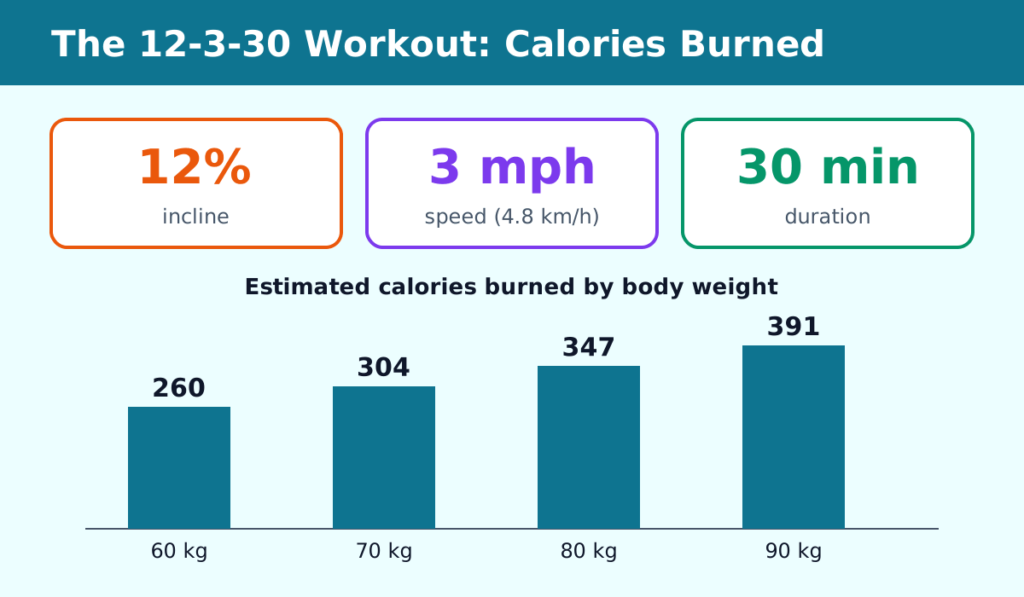
| Body weight | Total calories (30 min) | Net calories (30 min) |
|---|---|---|
| 60 kg (132 lb) | 260 | 229 |
| 70 kg (154 lb) | 304 | 267 |
| 80 kg (176 lb) | 347 | 305 |
| 90 kg (198 lb) | 391 | 343 |
It is not magic, but it is effective for three reasons: the incline raises your heart rate without the pounding of running, it works your glutes, hamstrings and calves harder than flat walking, and it is easy to repeat consistently. Beginners should start with a lower incline (for example 6% to 8%) and build up. If your lower legs, Achilles tendons or back feel uncomfortable, reduce the incline. You can track your effort with our Heart Rate Zone Calculator.
How much does incline increase calories?
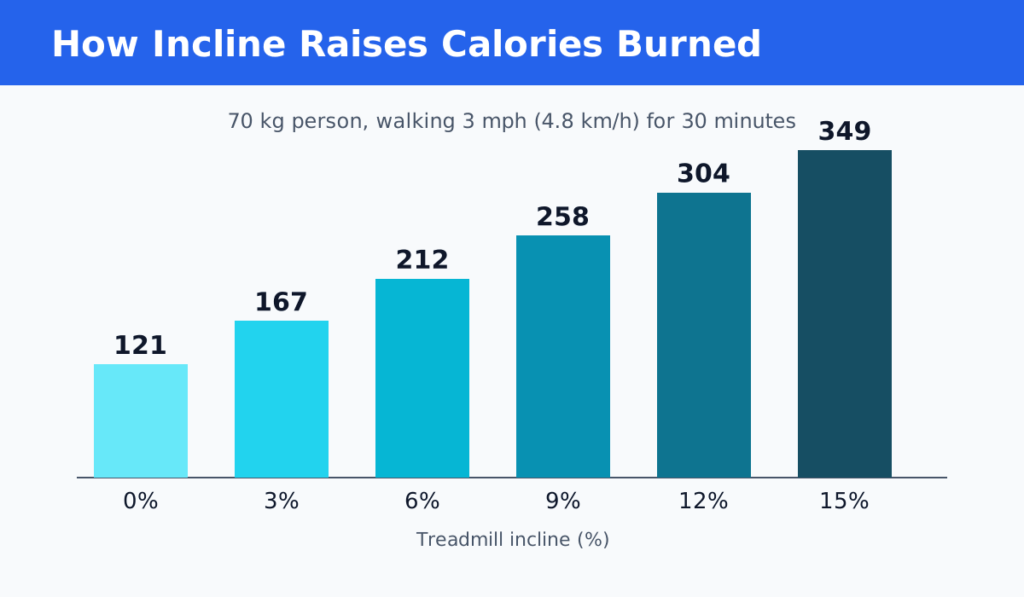
Every extra percent of incline makes walking noticeably harder. Here is a 70 kg person walking at 3 mph for 30 minutes:
| Incline | Total calories (30 min) |
|---|---|
| 0% | 121 |
| 3% | 167 |
| 6% | 212 |
| 9% | 258 |
| 12% | 304 |
| 15% | 349 |
In this example, walking at 12% burns roughly two and a half times the calories of walking flat at the same speed.
Walking vs running on a treadmill
Running burns more calories per minute, but incline walking can come close to easy jogging.
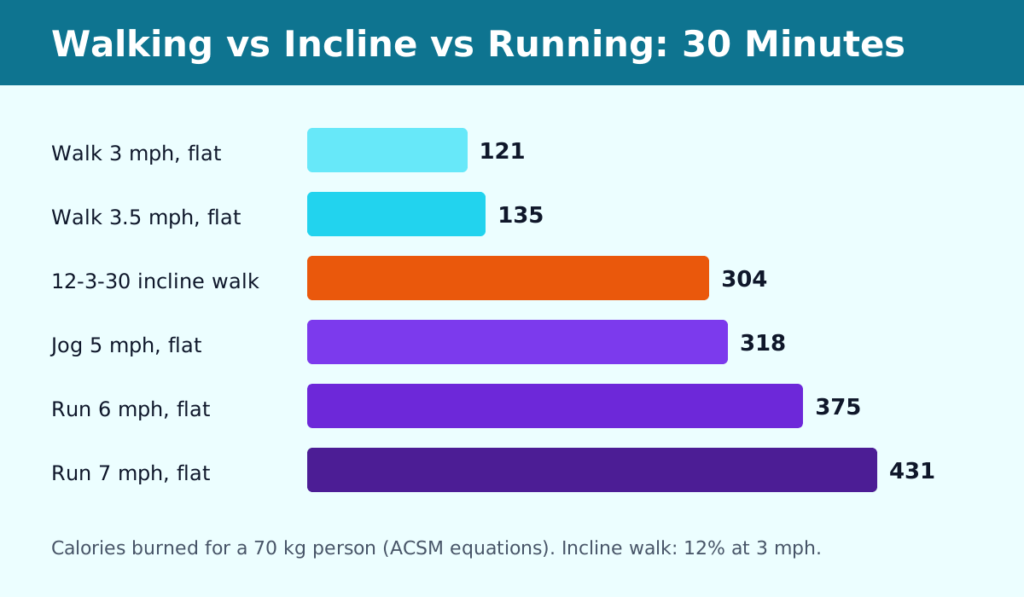
Calories for 30 minutes of flat walking
| Body weight | 2.5 mph | 3 mph | 3.5 mph | 4 mph |
|---|---|---|---|---|
| 60 kg (132 lb) | 92 | 104 | 116 | 128 |
| 70 kg (154 lb) | 107 | 121 | 135 | 149 |
| 80 kg (176 lb) | 122 | 139 | 155 | 171 |
| 90 kg (198 lb) | 138 | 156 | 174 | 192 |
Calories for 30 minutes of flat running
| Body weight | 5 mph | 6 mph | 7 mph | 8 mph |
|---|---|---|---|---|
| 60 kg (132 lb) | 273 | 321 | 369 | 418 |
| 70 kg (154 lb) | 318 | 375 | 431 | 487 |
| 80 kg (176 lb) | 364 | 428 | 493 | 557 |
| 90 kg (198 lb) | 409 | 482 | 554 | 627 |
To compare running pace across different distances, try our Pace Calculator.
How long to burn 500 calories on a treadmill
For a 70 kg person, based on total calories:
- 12-3-30 incline walk: about 49 minutes
- Running at 6 mph: about 40 minutes
- Walking at 3.5 mph (flat): about 111 minutes
If your goal is fat loss, remember that exercise is only one side of the equation. Plan your deficit with the Calorie Deficit Calculator.
Are treadmill calorie counters accurate?
Not very. Most treadmill screens and wearables are estimates, and they can read high. Several things explain the difference:
- Many consoles use a generic body weight unless you enter yours.
- Holding the handrails lowers the real work your body does, but the console usually does not account for it.
- Fitness trackers guess from heart rate and motion, which can be affected by stress, caffeine and heat.
- Equations are averages. Your true burn can differ by roughly 10% to 20% because of fitness, walking style and body composition.
Use the calculator as a consistent guide, not a precise measurement. If the number on your treadmill is much higher than ours, trust the lower figure when planning your food.
Does a 1% incline matter?
Yes, for running. Research in the 1990s found that a 1% treadmill incline roughly matches the energy cost of running outdoors, because it offsets the lack of air resistance. If you want treadmill runs to feel like outdoor runs, set the incline to about 1%.
Tips to burn more calories on the treadmill
- Add incline gradually. It is the easiest way to raise intensity without running.
- Let go of the handrails. Swing your arms naturally and use your own balance.
- Try intervals. Alternate two minutes hard with two minutes easy.
- Increase duration slowly. Add five minutes per week instead of jumping straight to an hour.
- Wear a weighted vest only if you are experienced. Extra load raises calorie burn, but it also stresses joints.
- Stay consistent. Three to five sessions per week beat one huge session.
Drink enough fluids around your workouts. You can check your daily target with our Water Intake Calculator.
Treadmill walking and steps
One mile is roughly 2,000 to 2,250 steps for most adults. Convert your treadmill distance into steps or the other way around with our Steps to Miles Calculator.For a 70 kg person walking at 3 mph, one mile burns about 80 total calories on a flat treadmill.
Who should be careful?
Talk to a doctor before starting a new exercise programme if you have heart disease, high blood pressure, diabetes, joint problems, are pregnant, or have been inactive for a long time. Stop if you feel chest pain, dizziness or severe breathlessness.
Frequently asked questions
How many calories does a treadmill burn in 30 minutes?
It depends on your weight, speed and incline. A 70 kg person burns about 121 calories walking at 3 mph flat, about 304 on the 12-3-30 workout and about 375 running at 6 mph.
How many calories does 12-3-30 burn?
For a 70 kg person, about 300 total calories (around 267 net). Lighter people burn less, and heavier people burn more. A 60 kg person burns about 260 and a 90 kg person about 391.
Is 12-3-30 good for weight loss?
It can help because it burns a meaningful number of calories with low impact and is easy to repeat. Weight loss still depends on your overall calorie balance, so combine it with sensible eating.
How many calories does walking one mile on a treadmill burn?
For a 70 kg person at 3 mph on a flat treadmill, about 80 total calories. A higher speed, a higher incline or a heavier body weight increases this.
How many calories are in 10,000 steps on a treadmill?
Ten thousand steps is roughly 4.5 to 5 miles. For most people this is about 300 to 450 calories depending on body weight and speed.
Does incline burn more calories than speed?
Both help. For walking, increasing the incline raises calorie burn more efficiently than going faster, because walking quickly eventually becomes awkward. Running burns more per minute than walking at any incline you can sustain.
What is the best incline for fat loss?
There is no special incline that burns fat. Choose an incline that lets you keep a challenging but sustainable effort for the whole session. Many people use 6% to 12%.
Is walking or running better on a treadmill?
Running burns more calories per minute, while walking is gentler on joints and easier to repeat daily. The best choice is the one you can do consistently.
Why is my treadmill showing more calories than the calculator?
Treadmill consoles often use rough estimates and may not account for handrail support or your exact weight. Equation-based calculators are usually closer to reality.
Should I use total calories or net calories?
Total calories include your resting burn. Net calories show only the extra energy from exercise. If you track food intake, net calories are the safer number to use.
What are METs?
A MET is a measure of exercise intensity. One MET is the energy you use sitting still. Walking at 3 mph on a 12% incline is around 8 METs, which means about eight times your resting energy use.
Does holding the handrails reduce calories burned?
Yes. Holding on takes some of the work away, so your real calorie burn can be noticeably lower than the number shown. Try to walk without support whenever it is safe.
How do I convert km/h to mph?
Divide km/h by 1.609 to get mph, or multiply mph by 1.609 to get km/h. For example, 4.8 km/h is about 3 mph.
Can I do 12-3-30 every day?
Many people do it three to five times a week. Build up gradually, take rest days if you feel sore, and stop if you feel pain in your knees, Achilles tendons or back.
What speed should a beginner use on the treadmill?
Start with a comfortable brisk walk of about 2.5 to 3.5 mph (4 to 5.6 km/h) at 0% to 2% incline, then increase the incline or time slowly.
Does body weight change how many calories I burn?
Yes. Heavier people burn more calories doing the same workout because they move more mass.
Why set the treadmill to 1% incline when running?
A 1% incline roughly matches the effort of outdoor running by making up for the missing air resistance.
Is this calculator accurate for everyone?
It is accurate on average. Individual results can differ by roughly 10% to 20%, so use it for planning and track your real progress with the scale, the mirror and your fitness.
Key takeaways
- Calories burned = VO2 × body weight × minutes × 0.005, using the ACSM walking or running equation.
- A 70 kg person burns about 121 calories walking flat, about 304 on 12-3-30 and about 375 running at 6 mph, all in 30 minutes.
- Incline is the easiest way to increase intensity without running.
- Treadmill screens can overstate calories, especially if you hold the handrails.
- Use net calories if you track food, and stay consistent rather than chasing a perfect number.
References
- Glass S, Dwyer GB (eds). ACSM’s Metabolic Calculations Handbook. Lippincott Williams & Wilkins, 2007.
- Jones AM, Doust JH. A 1% treadmill grade most accurately reflects the energetic cost of outdoor running. Journal of Sports Sciences, 1996.
- Ainsworth BE et al. Compendium of Physical Activities. Medicine & Science in Sports & Exercise.