
This calculator is for general information only and is not medical advice. Speak to a doctor or qualified professional before starting or changing an exercise programme.
Rucking Calorie Calculator
Calories burned by pack weight, speed, incline & terrain
Calculated with the Pandolf load-carriage equation. It is an estimate and can differ from your true burn by 10 to 20 percent, especially at fast speeds. Not medical advice.
Rucking Calorie Calculator: Pack Weight, Speed & Terrain
An 80 kg (176 lb) person carrying a 10 kg (22 lb) pack and walking at 3.5 mph (5.6 km/h) on flat pavement burns about 387 calories per hour. Rucking burns more than ordinary walking, but the pack itself adds less than most people expect. Speed, incline and terrain usually matter far more than pack weight. Our free rucking calorie calculator uses the Pandolf load-carriage equation to estimate your calories from your body weight, pack weight, speed, incline, terrain and time.
How to use the rucking calorie calculator
- Choose metric (kg and km/h) or imperial (lb and mph).
- Select your terrain, from pavement to loose sand.
- Enter your body weight and the weight of your loaded pack (the pack plus everything inside it).
- Enter your walking speed and the average incline of your route.
- Enter how long you will ruck, then press Calculate Rucking Calories.
In a hurry? Use the Beginner ruck, Standard ruck or Hilly trail ruck presets. If you want to compare rucking with other activities, try our Calories Burned Calculator.
What is rucking?
Rucking is walking with a weighted backpack. It comes from military training, but today it is popular as a low-impact way to build cardio fitness and leg and back endurance without running. You can ruck on pavement, trails, hills or a treadmill, and you can make it harder in four ways: more pack weight, more speed, more incline or rougher terrain.
How the calculator works
The calculator uses the Pandolf equation, a well-known formula for the energy cost of walking while carrying a load. It combines your body weight (W, kg), pack weight (L, kg), speed (V, metres per second), incline (G, percent) and a terrain factor (η):
Energy (watts) = 1.5W + 2.0(W + L)(L ÷ W)² + η(W + L)(1.5V² + 0.35VG)
Watts are then converted to calories: 1 watt is about 0.8604 kcal per hour.
Terrain factors
| Terrain | Terrain factor (η) |
|---|---|
| Pavement or treadmill | 1.0 |
| Dirt or gravel road | 1.1 |
| Light trail or brush | 1.2 |
| Heavy brush or rough trail | 1.5 |
| Loose sand | 2.1 |
Worked example
An 80 kg person carries a 10 kg pack at 5.6 km/h (1.556 m/s) on flat pavement.
- 1.5 × 80 = 120
- 2.0 × 90 × (10 ÷ 80)² = 2.8
- 1.0 × 90 × (1.5 × 1.556²) = 326.7
Energy = 120 + 2.8 + 326.7 = 449.5 watts, which is about 387 kcal per hour.
How much does pack weight add?
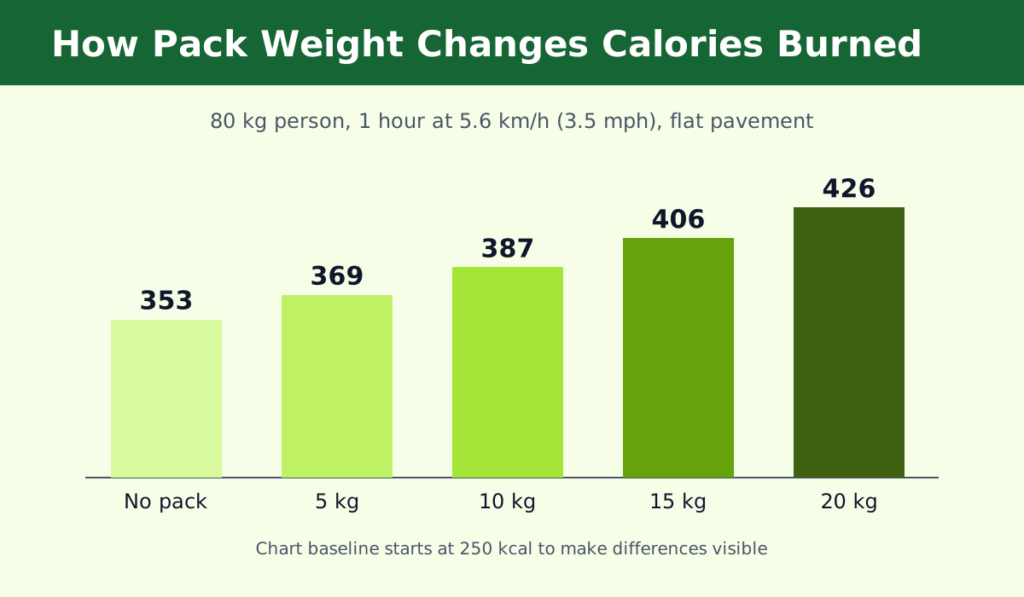
Less than many websites claim. For an 80 kg person walking at 3.5 mph on flat pavement for one hour:
| Pack weight | Calories per hour | Extra vs no pack |
|---|---|---|
| No pack | 353 | – |
| 5 kg (11 lb) | 369 | +16 |
| 10 kg (22 lb) | 387 | +34 |
| 15 kg (33 lb) | 406 | +53 |
| 20 kg (44 lb) | 426 | +73 |
So a 10 kg pack adds roughly 10% and a 20 kg pack roughly 20% on flat ground. That is real, but it is not a huge number. The bigger benefit of a pack is the strength and endurance training for your legs, hips and upper back.
Calories per hour by body weight (1 hour, 3.5 mph, flat pavement)
| Body weight | No pack | 5 kg pack | 10 kg pack | 15 kg pack |
|---|---|---|---|---|
| 60 kg (132 lb) | 265 | 281 | 299 | 320 |
| 70 kg (154 lb) | 309 | 325 | 343 | 363 |
| 80 kg (176 lb) | 353 | 369 | 387 | 406 |
| 90 kg (198 lb) | 397 | 413 | 431 | 449 |
Terrain and incline matter more than weight
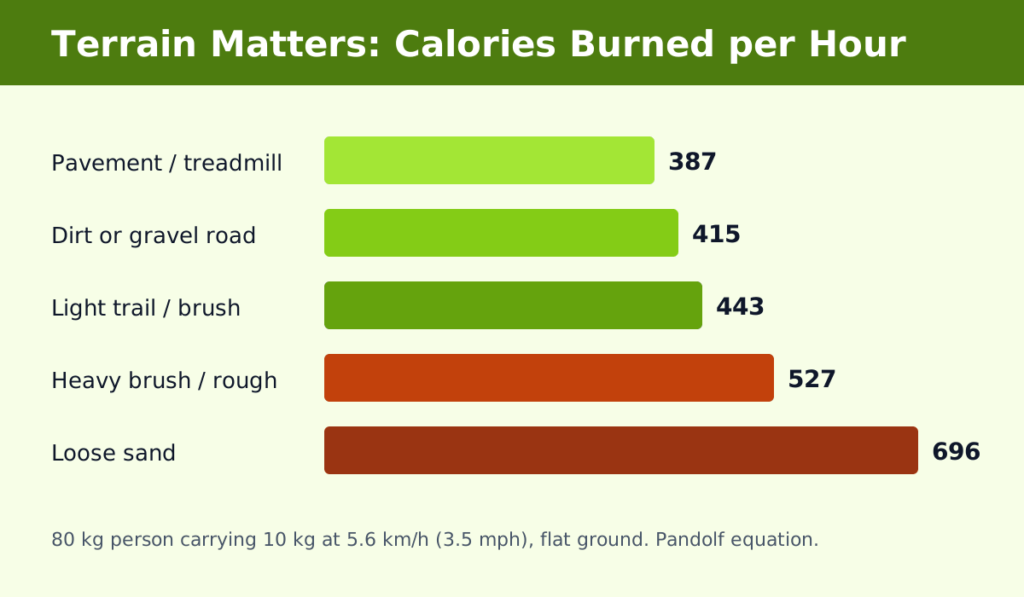
Changing the ground or the hill burns far more than adding a few kilograms. Here is an 80 kg person carrying 10 kg at 3.5 mph:
| Terrain (flat) | Calories per hour |
|---|---|
| Pavement | 387 |
| Dirt or gravel road | 415 |
| Light trail | 443 |
| Heavy brush | 527 |
| Loose sand | 696 |
| Incline (pavement) | Calories per hour |
|---|---|
| 0% | 387 |
| 3% | 513 |
| 6% | 640 |
| 9% | 766 |
If you only have a treadmill, you can raise the incline to get the same effect. Compare your numbers with our Treadmill Calorie Calculator.
How speed changes calories
For the same 80 kg person carrying 10 kg on flat pavement:
| Speed | Calories per hour |
|---|---|
| 2.5 mph (4.0 km/h) | 249 |
| 3.0 mph (4.8 km/h) | 312 |
| 3.5 mph (5.6 km/h) | 387 |
| 4.0 mph (6.4 km/h) | 473 |
Walking faster raises calorie burn quickly, but ruck pace is usually slower than normal walking pace, especially with a heavy pack or on hills. A good goal for most beginners is a steady 3 to 3.5 mph (about 4.8 to 5.6 km/h).
How heavy should your pack be?
A common rule of thumb is to start at about 10% of your body weight and build toward 15% to 20% over several weeks. Loads above 30% of body weight are not recommended for most people because they raise injury risk and change your walking posture.
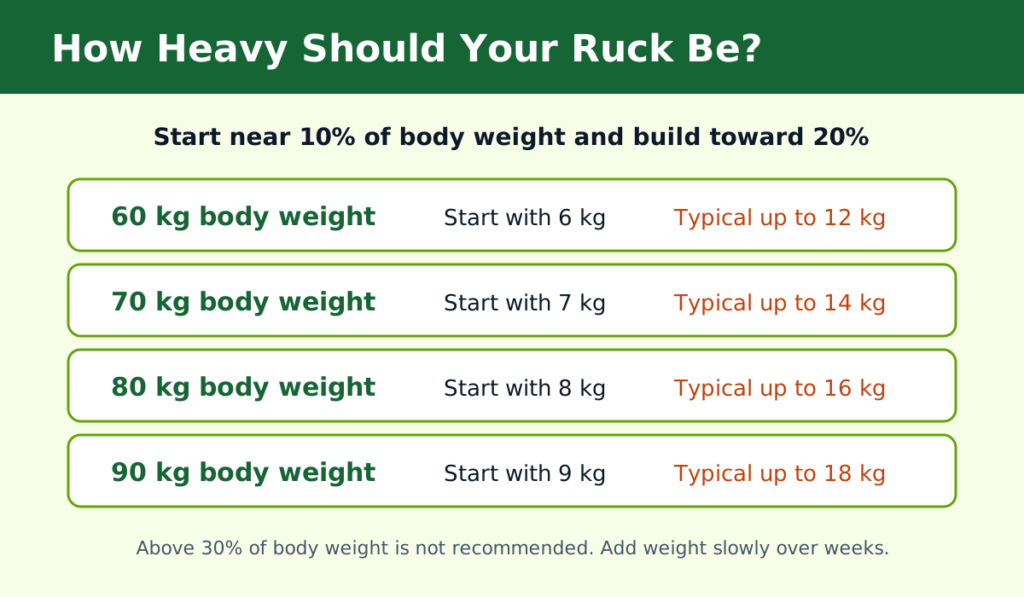
Increase the weight gradually, for example by 1 to 2 kg every week or two, and add distance before you add weight. If your shoulders, lower back, knees or feet hurt, reduce the load.
Rucking for weight loss
Rucking can support weight loss because it burns more than normal walking and is easy on the joints, so many people can do it often. For an 80 kg person carrying 10 kg at 3.5 mph, it takes about 78 minutes to burn 500 calories on flat ground, or about 47 minutes on a 6% incline.
Weight loss still depends on your overall calorie balance. Plan your target with our Calorie Deficit Calculator and use rucking as one part of your week, not the only part.
Rucking distance, pace and steps
At 3.5 mph (5.6 km/h), you cover about 3.5 miles (5.6 km) per hour. Heavier packs, hills and rough trails will slow you down. The calculator shows your distance, pace and calories per mile or kilometre. For an 80 kg person carrying 10 kg at 3.5 mph, rucking burns roughly 111 calories per mile. To convert distance into steps, use our Steps to Miles Calculator.
How hard should rucking feel?
Aim for a pace where you can speak in short sentences but not sing. Rucking should feel like brisk walking with extra effort, not a sprint. You can check your effort against your own heart rate using the Heart Rate Zone Calculator. If you feel dizzy, get chest pain or become unusually breathless, stop and rest.
Safety and technique tips
- Carry the weight high and tight. Place heavy items close to your back, between your shoulder blades.
- Use a hip belt and sternum strap. They move load off your shoulders.
- Keep your posture tall. Do not lean far forward or let your shoulders round.
- Take shorter steps. Short, quick steps are easier on your knees and hips.
- Wear comfortable shoes and moisture-wicking socks. Blisters stop more rucks than fitness does.
- Build up slowly. Increase weight or distance by about 10% per week at most.
- Stay hydrated. You sweat more with a pack, especially in warm weather. Check your daily target with our Water Intake Calculator.
- Take rest days. Your tendons and joints adapt more slowly than your lungs.
What to put in your pack
You can use sandbags, water bottles, books, a weighted vest or dedicated rucking plates. Whatever you use, pack it so nothing shifts around. Sandbags and rucking plates are compact. Water bottles are easy to adjust and can be emptied at the end of your walk.
Sample 4-week beginner rucking plan
| Week | Sessions | Pack weight | Duration |
|---|---|---|---|
| 1 | 2 | 5% to 10% of body weight | 30 minutes |
| 2 | 2 to 3 | about 10% of body weight | 40 minutes |
| 3 | 3 | 10% to 12% of body weight | 45 minutes |
| 4 | 3 | 12% to 15% of body weight | 50 to 60 minutes |
Walk on flat ground at a comfortable pace and add hills only after the first two weeks. Skip a session if you feel pain beyond normal muscle tiredness.
How accurate is the calculator?
The Pandolf equation is widely used, but it is still an estimate. Real calorie burn depends on your fitness, walking style, how well your pack fits and even the weather. Studies of load-carriage equations have found that errors can be larger at faster speeds, with downhill walking, and with unusual loads. Think of the result as a good guide for planning, not an exact measurement, and expect it to differ from your true burn by roughly 10% to 20%.
Fitness watches often give higher numbers than the equation because they do not always account for the way a pack changes your movement. If you are unsure, use the lower figure when planning your food.
Frequently asked questions
How many calories does rucking burn per hour?
For an 80 kg person carrying 10 kg at 3.5 mph on flat pavement, about 387 calories per hour. It can be over 600 per hour on a hill or in sand.
Does rucking burn more calories than walking?
Yes, but only moderately on flat ground. A 10 kg pack adds roughly 10% for an 80 kg person. Hills and rough terrain add much more than the pack does.
How many calories does rucking burn per mile?
For an 80 kg person with a 10 kg pack at 3.5 mph on pavement, about 111 calories per mile. Heavier body weight, more pack weight, hills and rough terrain all raise this.
Is rucking better than running for fat loss?
Running burns more calories per minute, while rucking is gentler on the joints and easier to do often. The best choice is the one you can do consistently.
How much weight should I carry when rucking?
Start at about 10% of your body weight and build toward 15% to 20% over several weeks. Loads above 30% are not recommended for most people.
How long should I ruck for?
Beginners can start with 30 to 45 minutes. As you adapt, many people ruck for 60 to 90 minutes, two to four times a week.
How fast should I ruck?
A steady 3 to 3.5 mph (4.8 to 5.6 km/h) is a good target for beginners. Slow down on hills, rough ground and when your pack is heavy.
Is rucking good for building muscle?
It builds muscular endurance in your legs, glutes, hips and upper back, but it is not a replacement for strength training with heavier weights.
Can I ruck on a treadmill?
Yes. Use a secure pack, keep the speed modest and raise the incline for more challenge. Check the machine’s weight limit first.
Does a weighted vest burn the same as a rucksack?
The energy cost is similar if the weight is the same and sits close to your body. A vest keeps the load closer to your centre, which some people find more comfortable.
Does rucking hurt your knees or back?
It can if your pack is too heavy or you increase the load too fast. Use a well-fitted pack, shorter steps and gradual progression, and speak to a doctor if you have joint or back problems.
How often should I ruck?
Two to four times per week works for most people, with at least one rest day between harder sessions.
Is the calculator accurate for women and men?
Yes. The equation uses body weight, pack weight, speed, incline and terrain, not sex, so it works for everyone. Individual results can still differ by 10% to 20%.
Why does my watch show more calories than the calculator?
Watches estimate from motion and heart rate and can overstate the effect of a pack. Equation-based estimates are usually more conservative.
Do I need to count the weight of my water and gear?
Yes. Enter the total weight of the loaded pack, including water, food and anything else inside it.
Can I use this calculator for hiking?
Yes. Choose the terrain that matches your trail, enter your average incline and your total moving time. Rest stops should not be counted.
What should I eat after rucking?
A meal with carbohydrates and protein helps recovery. The right amount depends on your daily calorie target and goals.
Key takeaways
- An 80 kg person with a 10 kg pack burns about 387 calories per hour at 3.5 mph on flat pavement.
- A pack adds roughly 10% to 20% on flat ground, but terrain and incline can add much more.
- Start with about 10% of your body weight and increase slowly.
- Carry the load high and tight, build gradually and rest enough.
- Treat the result as a guide that can differ from your true burn by 10% to 20%.
References
- Pandolf KB, Givoni B, Goldman RF. Predicting energy expenditure with loads while standing or walking very slowly. Journal of Applied Physiology, 1977.
- Looney DP et al. Estimating energy expenditure during level, uphill and downhill walking. Medicine & Science in Sports & Exercise, 2019.