

How Much Weight Should I Have Gained by 20 Weeks Pregnant in Kg?
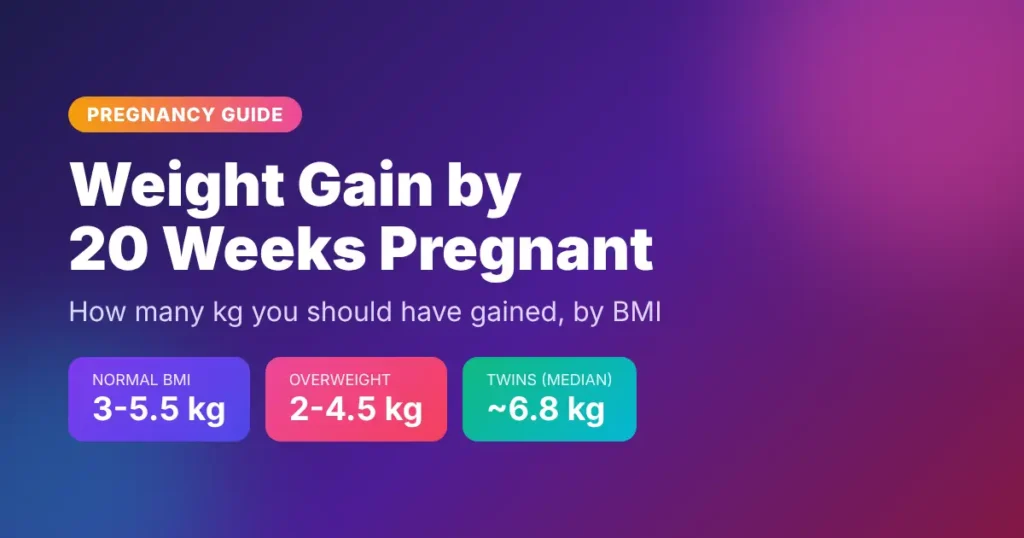
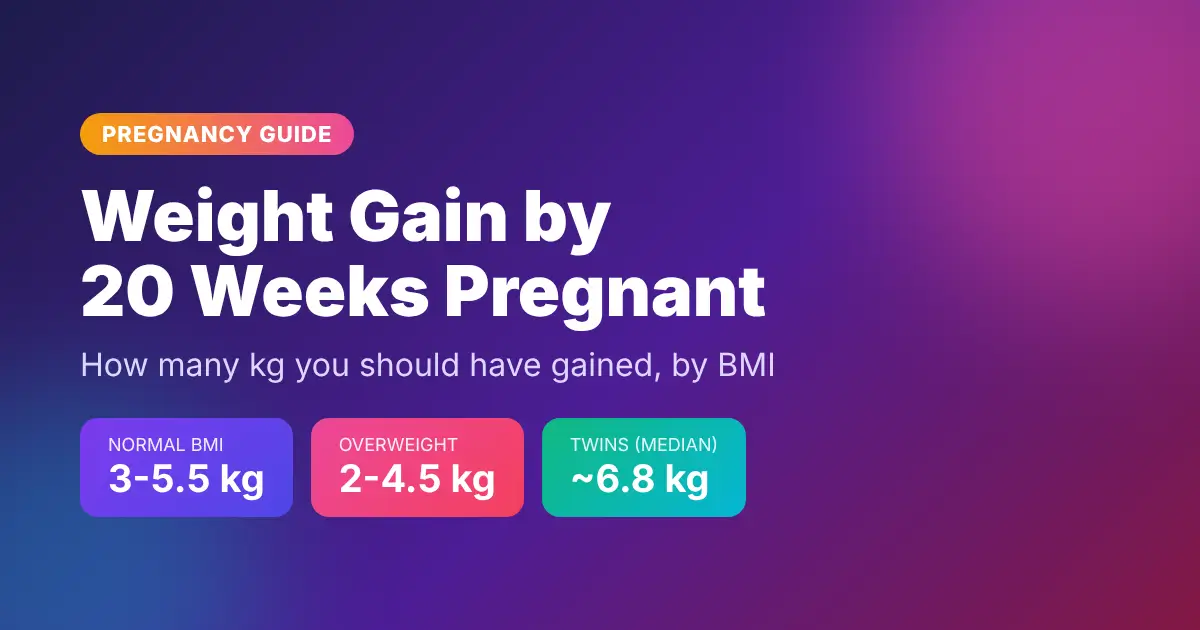
How much weight should you have gained by 20 weeks pregnant? If your BMI was normal before pregnancy and you are carrying one baby, most women have gained about 3 to 5.5 kg by 20 weeks. This comes from a small gain of 0.5 to 2 kg in the first trimester, followed by about 0.35 to 0.5 kg per week. If you were overweight before pregnancy, the expected range is lower, about 2 to 4.5 kg. With twins, gain is usually higher. A smaller gain in the first 20 weeks is also common, especially if you had morning sickness.
Please note: This article is for general information only and is not medical advice. Weight gain differs from woman to woman. Always follow your doctor’s or midwife’s advice about your own pregnancy.
How Much Weight Should You Gain by 20 Weeks Pregnant?
Most weight gain in pregnancy happens in the second and third trimesters. The US Institute of Medicine (IOM) 2009 guidelines assume a gain of 0.5 to 2 kg in the first trimester for all women, and then give a weekly rate for the rest of pregnancy based on your pre-pregnancy BMI. Using those figures, here is what you would expect by week 20 (counting about 7 weeks after the first trimester):
Expected gain by 20 weeks = first trimester gain (0.5–2 kg) + 7 weeks × weekly rate
Weight Gain by 20 Weeks by BMI (Single Baby)
| Pre-pregnancy BMI | Category | First trimester | Weekly rate after | Approx. gain by week 20 |
|---|---|---|---|---|
| Below 18.5 | Underweight | 0.5–2 kg | 0.44–0.58 kg | 3.5–6 kg |
| 18.5–24.9 | Normal weight | 0.5–2 kg | 0.35–0.50 kg | 3–5.5 kg |
| 25–29.9 | Overweight | 0.5–2 kg | 0.23–0.33 kg | 2–4.5 kg |
| 30 or more | Obese | 0.5–2 kg | 0.17–0.27 kg | 1.5–4 kg |
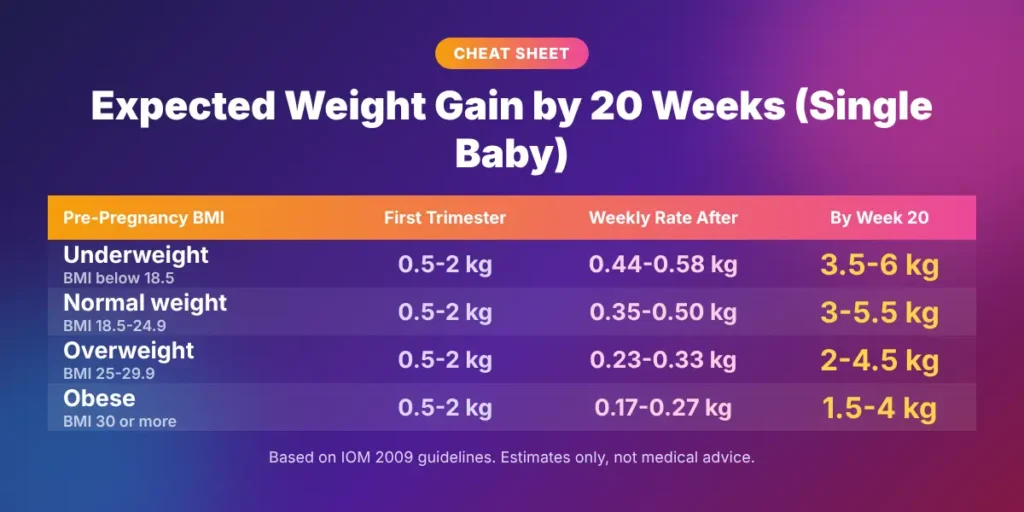
These week-20 numbers are estimates worked out from the IOM first-trimester and weekly rates, not official targets. Your doctor will look at your overall trend.
How to Check Your Own Number
- Find your pre-pregnancy BMI: weight in kg divided by height in metres squared.
- Choose your BMI category from the table above.
- Add the expected gain to your pre-pregnancy weight.
Example: a woman who weighed 60 kg and is 160 cm tall had a BMI of 23.4 (normal). At 20 weeks, an expected gain of 3 to 5.5 kg puts her weight at about 63 to 65.5 kg.
Use your weight before pregnancy or at your first booking visit. If you do not know your height or weight, ask at your next antenatal visit.
How Much Weight Should I Gain by 20 Weeks If My BMI Was Normal?
With a normal BMI (18.5–24.9), the IOM recommends a total of 11.5 to 16 kg for the whole pregnancy with one baby. By 20 weeks, that works out to about 3 to 5.5 kg. After the first trimester, the target is about 0.35 to 0.5 kg per week (roughly 0.8 to 1 lb).
How Much Weight Should I Gain by 20 Weeks If I Was Overweight?
With a BMI of 25 to 29.9, the IOM recommends a total gain of 7 to 11.5 kg, at a slower weekly rate of 0.23 to 0.33 kg after the first trimester. By 20 weeks, that is about 2 to 4.5 kg. With a BMI of 30 or more, the total recommendation is 5 to 9 kg, so the gain by week 20 is lower again, about 1.5 to 4 kg.
How Much Weight Should I Gain by 20 Weeks With Twins?
Twin pregnancies need more weight gain. The IOM’s provisional (limited-evidence) total gain recommendations for twins are about 17 to 25 kg for normal weight, 14 to 23 kg for overweight and 11 to 19 kg for obesity. There is no IOM recommendation for underweight women carrying twins.
The IOM has not published a standard week-20 target for twins. In one large cohort of twin pregnancies, the median gain at 20 weeks was about 6.8 kg for women with a normal BMI, 5.7 kg for overweight and 3.6 kg for obese. These are averages, and individual gain varies a lot. Your doctor will track your weight against your own scans and growth.
Is It Normal to Gain Only a Little Weight in the First 20 Weeks?
Yes, it can be. A first-trimester gain of only 0.5 to 2 kg is normal, and some women gain nothing or even lose a little weight because of nausea and vomiting. This is not usually a concern if you are eating enough again afterwards and your baby is growing well. Low gain can be normal if:
- You had morning sickness or food aversions early on
- You were overweight before pregnancy and your target is lower
- Your baby’s growth on scans is on track
Talk to your doctor or midwife if you keep losing weight, cannot keep food or drink down, feel very weak, or have been told your baby is small. Do not try to diet during pregnancy unless your doctor advises it.
Is It a Problem If I’ve Gained More Than Expected?
Gaining more than the range does not always mean a problem. Weight can rise from fluid, a growing baby and breast tissue. But rapid weight gain, especially with swelling in the face or hands, severe headaches or vision changes, should be checked straight away by your doctor, as these can be signs of high blood pressure problems.
Where Does the Weight Go?
Pregnancy weight is not only fat. It includes the baby, placenta, amniotic fluid, a larger uterus, bigger breasts, extra blood and fluid, and some stored fat for breastfeeding. This is why gain is slow early on and speeds up later.
Do Guidelines Differ by Country?
Yes. The IOM guidelines use the WHO BMI categories. Some countries use different BMI cutoffs or ranges. For example, China’s standard recommends a total gain of 8 to 14 kg for normal-weight women instead of 11.5 to 16 kg. Follow the guidance your doctor uses.
Healthy Habits for Weight Gain in Pregnancy
- Eat regular, balanced meals with protein, vegetables, fruit and whole grains
- Choose healthy snacks rather than “eating for two”
- Stay active with gentle exercise if your doctor says it is safe
- Weigh yourself at antenatal visits rather than every day
Related tools
- Not pregnant yet? Try the Ovulation Calculator and the Pregnancy Test Date Calculator.
- Know your conception date? Use the Conception Due Date Calculator.
- Having IVF? Use the IVF Due Date Calculator.
- Want to check your BMI? Use the BMI Calculator.
- Preparing for birth? Use the Kick Counter, the Contraction Timer and the Hospital Bag Checklist.
- Planning ahead? Try the Baby Budget Calculator and the Baby Name Generator.
- After birth, use the Baby Age Calculator, the Baby Weight Percentile Calculator and the Baby Feeding Reminder.
Frequently Asked Questions
How much weight should I have gained by 20 weeks pregnant in kg?
For a single baby and a normal pre-pregnancy BMI, about 3 to 5.5 kg. The range is about 3.5 to 6 kg if underweight, 2 to 4.5 kg if overweight and 1.5 to 4 kg if obese.
How much weight should you gain by 20 weeks pregnant?
It depends on your pre-pregnancy BMI. Most women gain 0.5 to 2 kg in the first trimester and then 0.2 to 0.6 kg per week, depending on BMI. Use the table above to find your range.
Is it normal to gain only a little weight in the first 20 weeks of pregnancy?
Yes. A first-trimester gain of 0.5 to 2 kg is normal, and some women gain nothing at first because of morning sickness. See your doctor if you keep losing weight or cannot eat or drink.
How much weight should I gain by 20 weeks if my BMI was normal before pregnancy?
About 3 to 5.5 kg. This is 0.5 to 2 kg in the first trimester plus about 0.35 to 0.5 kg per week after that.
How much weight should I gain by 20 weeks if I was overweight before pregnancy?
About 2 to 4.5 kg. The weekly rate after the first trimester is lower, about 0.23 to 0.33 kg per week.
How much weight should I gain by 20 weeks if I am pregnant with twins?
There is no official week-20 target. In a large study, the median gain at 20 weeks was about 6.8 kg for normal-BMI women, 5.7 kg for overweight and 3.6 kg for obese. Total recommended gain for twins is 17 to 25 kg for normal weight. Your doctor will guide you.
How much weight gain is too little at 20 weeks?
Gaining nothing or losing weight can be normal early on, but ongoing weight loss, vomiting and weakness need a doctor’s review.
How many kg should I gain per week in the second trimester?
Roughly 0.35 to 0.5 kg per week for normal BMI, 0.44 to 0.58 kg if underweight, 0.23 to 0.33 kg if overweight and 0.17 to 0.27 kg if obese.
Should I use my pre-pregnancy weight to work out my gain?
Yes. Use your weight before pregnancy, or your first weight in early pregnancy if you do not know it.
Bottom Line
By 20 weeks, most women with a normal pre-pregnancy BMI carrying one baby have gained about 3 to 5.5 kg. The range is lower if you were overweight and higher with twins. A small gain in early pregnancy is common and often fine. Check your own BMI range, and talk to your doctor or midwife about any worries.
References
- Institute of Medicine and National Research Council (2009). Weight Gain During Pregnancy: Reexamining the Guidelines. National Academies Press.
- Gilmore LA, et al. Weight gain in pregnancy and application of the 2009 IOM guidelines. Obesity. 2015.
- Lutsiv O, et al. Examining the provisional guidelines for weight gain in twin pregnancies. BMC Pregnancy and Childbirth. 2017;17:330.
- Hutcheon JA, et al. Pregnancy weight gain charts for twin pregnancies by BMI category. PMC5902642.
Disclaimer
This article is for educational purposes only and is not medical advice. Always consult your doctor or midwife.