
This article and calculator are for information only and do not replace advice from your child’s doctor. Data source: CDC 2000 growth charts, BMI-for-age, ages 2 to 20.
🧸 Child BMI Calculator
BMI-for-age percentile using CDC growth charts (ages 2 to 20). Not the adult BMI scale.
- Choose boy or girl.
- Enter your child's age in years and months (2 to 20 years).
- Pick kg/cm or lb/inches, then enter weight and height.
- Tap Calculate to see BMI, percentile and weight category.
Formula: BMI = weight (kg) / height (m)², then compared with CDC LMS reference values for the child's exact age and sex. This tool is for information only and is not a diagnosis. Please discuss results with your child's doctor.
Child BMI Calculator: What Is a Healthy BMI for a Child?
A healthy BMI for a child is a BMI between the 5th and 85th percentile for their age and sex on the CDC growth chart. Unlike adults, children are not judged by one fixed number. Enter your child’s age, sex, weight and height in the calculator above to get their BMI, their percentile and their weight category in a few seconds.
Parent measuring a child’s height and weight to use a child BMI calculator
1. How do I calculate my child’s BMI?
Divide your child’s weight in kilograms by their height in metres squared, then compare the result with the CDC chart for their exact age and sex. The second step is what turns a plain number into a percentile.
For example, a child who weighs 32 kg and is 135 cm (1.35 m) tall has a BMI of 32 ÷ (1.35 × 1.35) = 17.6. Whether 17.6 is healthy depends on age and sex, which is why you should not read it like an adult BMI. Our calculator does both steps for you. Measure height without shoes and weigh your child in light clothes for the most accurate result.
2. What BMI percentile should my child be?
A healthy BMI percentile for a child is from the 5th percentile up to, but not including, the 85th percentile. Anywhere in this range counts as healthy weight.
A percentile compares your child with 100 children of the same age and sex. A child at the 50th percentile is exactly in the middle. There is no “perfect” percentile inside the healthy range, and a child at the 20th percentile is just as healthy as one at the 70th. What doctors watch most closely is whether the child stays on a steady curve over time.
3. Is my child overweight for their age?
Your child is in the overweight range if their BMI is at the 85th percentile or higher but below the 95th percentile. At the 95th percentile or above, the category is obesity.
Use the calculator to see exactly where your child falls. A single reading is not a diagnosis. Children grow in spurts, and a doctor will look at height and weight over several visits, family history and eating and activity habits before drawing conclusions.
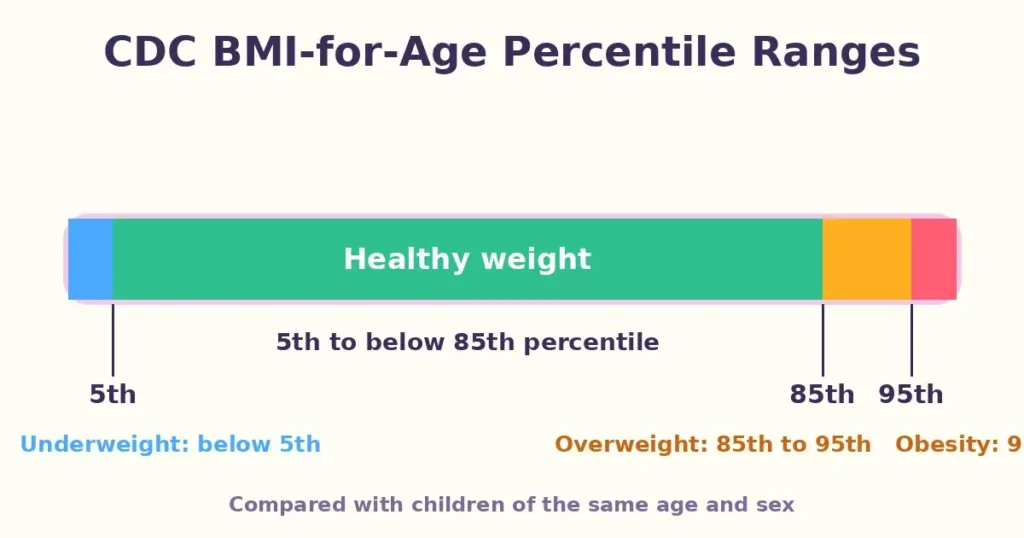
4. How do I know if my child is underweight, healthy weight, overweight or obese?
The CDC uses four categories based on BMI-for-age percentile.
| BMI-for-age percentile | Weight category |
|---|---|
| Below the 5th | Underweight |
| 5th to below the 85th | Healthy weight |
| 85th to below the 95th | Overweight |
| 95th or above | Obesity |
CDC BMI-for-age percentile chart showing underweight, healthy weight, overweight and obesity ranges for children
These cut-offs apply to children and teens aged 2 to 20. The calculator above shows your child’s category in colour and also tells you the BMI values that mark the 85th and 95th percentile for their age.
5. What is the BMI for a 10 year old?
There is no single BMI for a 10-year-old, because the healthy range depends on exact age in months and on whether the child is a boy or a girl. Using CDC data, a 10-year-old boy (aged 10 years and 0 months) has a median BMI of about 16.6, and a 10-year-old girl about 16.9.
At that same age, a boy is in the healthy range up to a BMI of about 19.4 (85th percentile), and overweight starts there. Obesity starts at about 22.2 (95th percentile). For a girl the 85th percentile is about 20.0 and the 95th is about 23.0. The 5th percentile, where underweight begins, is about 14.2 for boys and 14.0 for girls. These numbers change month by month, so use the calculator for your child’s exact age.
6. Why is BMI calculated differently for children than for adults?
The BMI formula is the same for children and adults, but the result is read differently. Adults use fixed ranges (for example, 18.5 to 24.9 is healthy). Children use percentiles for their age and sex, because their bodies are still growing and changing.
Body fat naturally rises and falls as a child grows. It tends to drop in the preschool years and then rise again, and it differs between boys and girls, especially during puberty. A BMI of 20 could be completely normal for a 16-year-old and high for a 7-year-old. A fixed adult range would label many healthy children incorrectly, so the CDC compares each child with a reference group of the same age and sex.
7. What does the 85th percentile mean for a child’s BMI?
The 85th percentile means your child’s BMI is higher than that of 85 out of 100 children of the same age and sex. It is the point where the overweight range begins.
Being at or just above the 85th percentile is a signal to pay attention, not a reason to panic. It is a good time to look at daily habits such as sugary drinks, portion sizes, sleep, screen time and physical activity, and to mention it at your next doctor visit.
8. What does the 95th percentile mean for a child’s BMI?
The 95th percentile means your child’s BMI is higher than that of 95 out of 100 children of the same age and sex. At or above this point, the CDC classifies the weight category as obesity.
This is the point at which it is wise to speak with your child’s doctor. The doctor may check blood pressure, blood sugar and cholesterol, and can suggest a plan that suits your family. The goal for most children is not weight loss but slowing weight gain while they keep growing taller.
9. How often should I check my child’s BMI?
For most children, checking BMI once a year at the regular check-up is enough. Doctors usually measure it at every well-child visit.
If your child is in the overweight or obesity range, or is underweight, your doctor may want to check more often, for example every few months. Weighing a child at home every week is not recommended, as it can create unhealthy focus on numbers. The trend across months and years tells you much more than one reading.
10. My child’s BMI percentile is high, what should I do?
If your child’s BMI percentile is high, book a visit with your child’s doctor first, and avoid putting your child on a strict diet or talking about weight in a negative way. Healthy habits for the whole family work better than rules for one child.
Helpful steps include:
- Eat meals together at regular times, and offer fruits and vegetables daily.
- Replace sugary drinks and packaged snacks with water, milk and healthier options.
- Aim for at least 60 minutes of active play every day.
- Limit screen time and make sure your child gets enough sleep for their age.
- Be positive and supportive, and focus on health rather than appearance.
A doctor or registered dietitian can build a plan that suits your child’s age, growth and culture.
11. Can a child have a high BMI but still be healthy?
Yes, it is possible. BMI measures weight relative to height, not body fat directly, so a very muscular or athletic child can have a high BMI and still be healthy.
BMI is a screening tool, not a diagnosis. A doctor looks at growth pattern, family history, blood pressure, blood tests and lifestyle before deciding whether a high BMI is a concern. The reverse also happens: a child with a BMI in the healthy range can still have unhealthy habits, so good food and activity matter for every child.
12. What is the BMI formula for children in kg and cm?
The formula is BMI = weight (kg) ÷ [height (cm) ÷ 100]². In other words, convert centimetres to metres, square the height, and divide the weight by it.
Example: a child weighing 25 kg with a height of 120 cm has a BMI of 25 ÷ (1.2 × 1.2) = 17.4. If you prefer pounds and inches, the formula is BMI = 703 × weight (lb) ÷ height (in)². For children, this BMI number is then plotted on the CDC chart to find the percentile, using a method based on three values called L, M and S for each age and sex.
13. At what age does BMI start for children?
The CDC BMI-for-age charts start at 2 years and go up to 20 years. This is the age range our calculator uses.
For babies and toddlers under 2, doctors use WHO growth charts that compare weight with length instead of BMI. Your child’s doctor will track these at routine baby check-ups.
14. Should I use the adult BMI calculator for my child?
No, you should not use an adult BMI calculator for a child, because it will give a misleading result. The adult scale ignores age and sex, so it can label a healthy child as underweight or overweight.
Always use a child BMI calculator that gives a BMI-for-age percentile based on the CDC charts, like the one on this page. Then discuss the result with your child’s doctor.