
Please note: This sweat rate calculator is for general information only and is not medical advice. Results are estimates for one session in one set of conditions. If you feel dizzy, confused or sick during exercise, stop and seek help.
💧 Sweat Rate Calculator
Find how much fluid and sodium you lose per hour, and how much to drink to replace it.
Your Sweat Rate Results
How to Use the Sweat Rate Calculator
Weigh yourself before exercise after using the toilet, with little or no clothing.
Exercise for about 60 minutes at your normal intensity. Note any fluid you drink and any urine you pass.
Dry off and weigh yourself again in the same clothing state.
Enter the numbers, choose your sweat saltiness, and tap Calculate Sweat Rate.
Sweat Rate Calculator: How Much Water Do You Lose During a One-Hour Run?
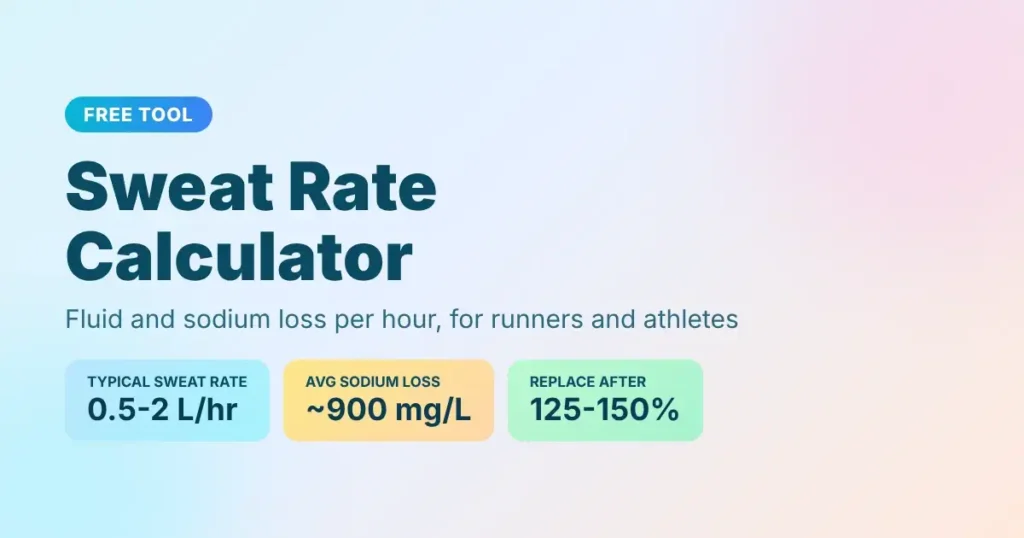
Most runners lose about 0.5 to 2 litres of sweat during a one-hour run. A typical amount in mild weather is about 1 to 1.5 litres. To find your own number, weigh yourself before and after the run. Every 1 kg you lose is about 1 litre of sweat. Use the sweat rate calculator below to get your sweat rate, how much to drink and how much sodium you lose.
Sweat rate is how much fluid you lose per hour of exercise. It changes with heat, humidity, your effort and your body. Knowing it helps you drink the right amount, not too little and not too much. This guide explains how to calculate it, what to drink and how much sodium you lose.
How to Use the Sweat Rate Calculator
- Weigh yourself before exercise after using the toilet, with little or no clothing.
- Exercise for about 60 minutes at your normal intensity. Note any fluid you drink and any urine you pass.
- Dry off and weigh yourself again in the same clothing state.
- Enter the numbers, choose your sweat saltiness, and tap Calculate Sweat Rate.
Repeat the test in hot and cool weather, because your sweat rate changes with conditions.
How Much Water Do I Lose During a One-Hour Run?
Most people lose about 0.5 to 2 litres per hour, but the range is wide. In one study of runners after a one-hour run in a temperate climate, the average sweat loss was about 1.35 litres, or around 1.9% of body weight. The same study found that runners guessed their loss much too low. They thought they had lost about 0.7 litres.
Your own loss depends on:
- Weather: heat and humidity raise sweat rate a lot
- Intensity: faster running means more sweat
- Body size and fitness: bigger and fitter people often sweat more
- Clothing: heavy or non-breathable clothes increase sweat
Sweat Rate Calculator for Runners and Athletes
The calculator uses the standard sweat rate formula, which is based on weighing yourself before and after exercise. You enter your two weights, the fluid you drank, any urine you passed and the time. It then gives your sweat rate, total sweat, how much to drink and your sodium loss. Because it only measures one session, repeat it in different weather for a fuller picture.
How Do I Work Out My Sweat Rate From My Weight Before and After a Workout?
Use this formula:
Sweat rate (L/hr) = (weight before − weight after + fluid drunk − urine) ÷ hours
Here is a worked example:
- Weight before: 70.0 kg
- Weight after: 69.2 kg (a loss of 0.8 kg)
- Fluid drunk: 400 ml (0.4 L)
- Urine passed: none
- Time: 1 hour
Sweat rate = (0.8 + 0.4) ÷ 1 = 1.2 L/hr
If you worked out for 90 minutes, divide by 1.5 instead of 1. To use pounds, convert to kg by dividing by 2.2.
How Much Should I Drink After Exercise to Replace Lost Fluids?
After exercise, drink about 125% to 150% of the weight you lost. For every 1 kg lost, that is about 1.25 to 1.5 litres. Spread it over the next 2 to 4 hours, and take some salty food or an electrolyte drink with it. This is more than you lost because you also lose fluid in urine as you rehydrate.
Example: you lost 0.8 kg. Drink about 1 to 1.2 litres over the next few hours.
During exercise, many guides suggest drinking about 60% to 80% of your sweat rate per hour. Do not try to match your sweat rate fully, and never drink more than you lose.
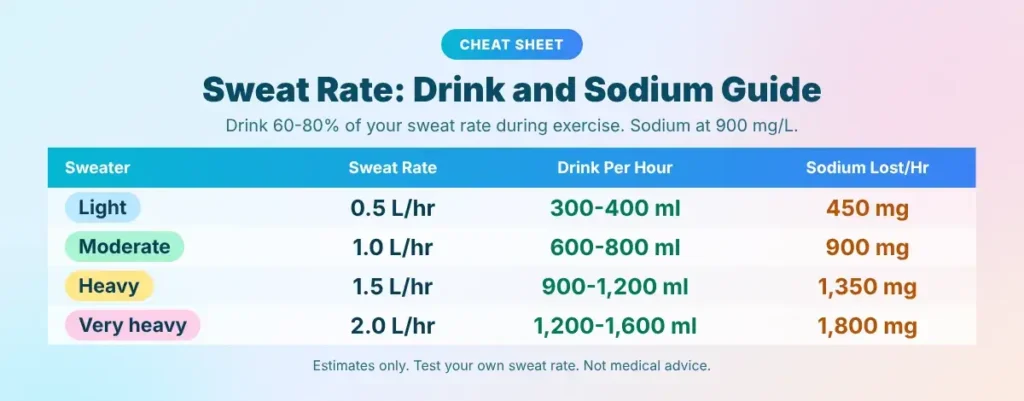
| Sweat rate | During exercise (60–80%) | Sodium lost per hour (at 900 mg/L) |
|---|---|---|
| 0.5 L/hr | 300–400 ml | about 450 mg |
| 1.0 L/hr | 600–800 ml | about 900 mg |
| 1.5 L/hr | 900–1,200 ml | about 1,350 mg |
| 2.0 L/hr | 1,200–1,600 ml | about 1,800 mg |
How Much Sodium Do I Lose in Sweat During Exercise?
On average, sweat contains about 900 to 1,000 mg of sodium per litre. However, the range is wide, from about 200 mg to 2,000 mg per litre. Your sodium loss per hour is your sweat rate multiplied by your sweat sodium level:
Sodium loss (mg/hr) = sweat rate (L/hr) × sweat sodium (mg/L)
Example: 1.5 L/hr × 1,200 mg/L = 1,800 mg of sodium per hour.
Sweat rate and saltiness are separate. You can sweat a lot without having salty sweat, or sweat little with very salty sweat. White salt marks on your clothes or skin and a salty taste are signs of salty sweat. The calculator uses 500, 900 or 1,500 mg/L as rough levels. A lab sweat test is the only exact way.
How Much Weight Loss Is Too Much?
- Under 1%: a small loss
- 1% to 2%: a mild loss
- Above 2%: performance can drop, and it gets harder on the body
- Above 3%: a large loss, so drink more next time
Gaining weight during exercise can be a sign of drinking too much, which can be dangerous.
Tips to Stay Hydrated When Running
- Start well-hydrated. Check that your urine is pale yellow.
- Sip regularly instead of gulping large amounts.
- Add sodium for runs longer than an hour or in hot weather, through a sports drink, salty snack or electrolyte tablets.
- Rehydrate after the run using your weight loss as a guide.
- Test again in different weather and at different intensities.
When Should I Talk to a Doctor?
Speak to a doctor if you often feel dizzy, confused, nauseous or get headaches during exercise. Also check with a doctor if you have kidney, heart or blood pressure conditions, or take medication that affects fluids, before changing your hydration habits.
Related Tools
- Steps to Miles Calculator
- Calories Burned by Activity Calculator
- Pace Calculator
- Running Calories Calculator
- Rucking Calorie Calculator
- Treadmill Calorie Calculator
- One Rep Max Calculator
- VO2 Max Calculator
Frequently Asked Questions About Sweat Rate
How much water do I lose during a one-hour run?
Most people lose about 0.5 to 2 litres per hour. In one study, runners lost about 1.35 litres on average in a one-hour run in mild weather.
What is the sweat rate calculator for runners and athletes?
It is a tool that works out your sweat rate from your weight before and after exercise, the fluid you drank, urine and time. It also estimates how much to drink and your sodium loss. Use the calculator above.
How much should I drink after exercise to replace lost fluids?
Drink about 125% to 150% of the weight you lost, spread over 2 to 4 hours. For 1 kg lost, that is about 1.25 to 1.5 litres.
How do I work out my sweat rate from my weight before and after a workout?
Use the formula: (weight before − weight after + fluid drunk − urine) ÷ hours. For example, 0.8 kg lost plus 0.4 L drunk in 1 hour gives 1.2 L/hr.
How much sodium do I lose in sweat during exercise?
On average, about 900 to 1,000 mg per litre of sweat, with a range of about 200 to 2,000 mg per litre. Multiply this by your sweat rate to get your hourly loss.
Does 1 kg of weight loss equal 1 litre of sweat?
Yes, approximately. That is why weight lost is used to measure sweat.
Should I weigh myself with clothes on?
Weigh yourself with the same minimal clothing before and after, and dry off sweat first for the second weigh-in.
How often should I test my sweat rate?
Test it a few times in different weather and intensities, because it changes with conditions.
Is it bad to drink too much water when running?
Yes. Drinking much more than you sweat can lower your blood sodium, which can be dangerous. Drink to match your needs, not more.
Bottom Line
Most runners lose about 0.5 to 2 litres of sweat per hour. Work out your own rate by weighing yourself before and after exercise, then drink about 60–80% of it during exercise and 125–150% of your weight loss afterwards. Add sodium for long or hot sessions. Use the sweat rate calculator above to get your numbers.
References
- CDC. Sweat Rate Calculation. cdc.gov (Heat Illness resource)
- Armstrong LE, et al. Fluid kinetics and perception of sweat losses following a 1-h run in a temperate environment. Nutrients. 2014;6(1):37–52. doi:10.3390/nu6010037
- Skratch Labs. Sweat Rate vs. Sweat Sodium Concentration. skratchlabs.com
- Athlo. Know Your Sweat Rate: How to Calculate Your Personal Hydration Needs. athlo.sg
Disclaimer
This article is for educational purposes only and is not medical advice. Consult a doctor before changing your hydration plan if you have a health condition.