
This carb cycling calculator is for healthy adults (18+) and gives general estimates only. It is not medical or dietitian advice. If you are pregnant, breastfeeding, have diabetes, kidney disease or an eating disorder, or take medication, speak to your doctor before changing your diet.
🥑 Carb Cycling Calculator
Get your high, moderate and low carb day macros and a full weekly plan.
Your Carb Cycling Plan
| Day | Type | Carbs | Protein | Fat | Calories |
|---|
How to Use the Carb Cycling Calculator
Enter your details: sex, age, weight (kg or lb) and height in cm.
Pick your activity level and goal: fat loss, maintain weight or build muscle.
Choose your week: how many high-carb days (your hardest workouts) and moderate days you want. The remaining days are low-carb.
Tap Calculate My Carb Cycle. You get macros for each day type and a 7-day plan. Move the days around to match your own training schedule.
Carb Cycling Calculator: How Many Carbs on High and Low Carb Days?
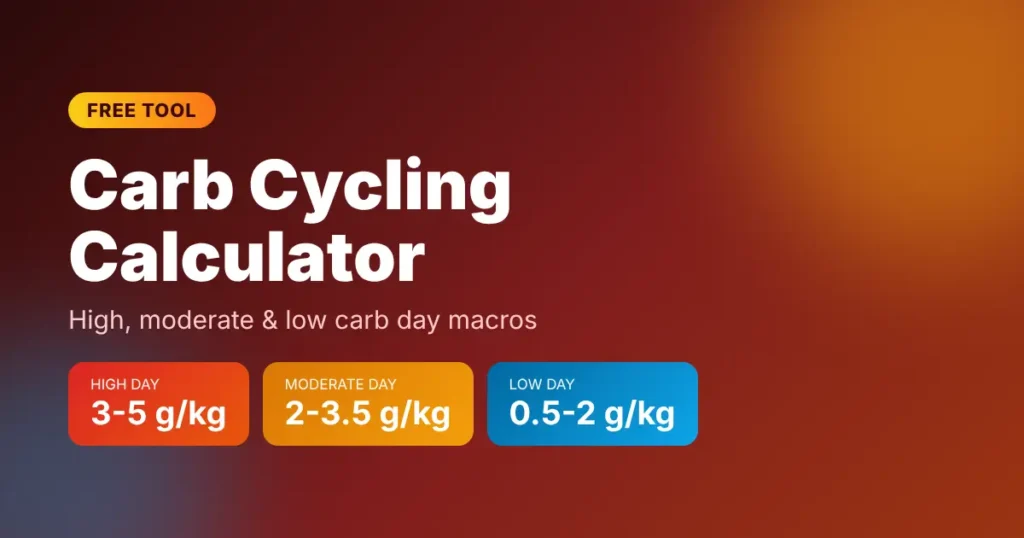
On high-carb days, eat about 3 to 5 grams of carbs per kg of body weight. On low-carb days, eat about 0.5 to 2 grams per kg. For example, an 80 kg adult who wants to lose fat eats roughly 280 g of carbs on a high day and 80 g on a low day. Use the carb cycling calculator below to get your own numbers and a 7-day plan
How to Use the Carb Cycling Calculator
- Enter your details: sex, age, weight (kg or lb) and height in cm.
- Pick your activity level and goal: fat loss, maintain weight or build muscle.
- Choose your week: how many high-carb days (your hardest workouts) and moderate days you want. The remaining days are low-carb.
- Tap “Calculate My Carb Cycle.” You get macros for each day type and a 7-day plan. Move the days around to match your own training schedule.
What Is Carb Cycling?
Carb cycling means changing how many carbs you eat from day to day instead of eating the same amount every day. High-carb days match your hardest training sessions, and low-carb days match rest days or easy days. Some plans add a moderate-carb day in between.
How Many Carbs Should I Eat on High and Low Carb Days?
| Day type | Carbs (g per kg body weight) | When to use it |
|---|---|---|
| High-carb | about 3–5 g/kg | Hardest training days |
| Moderate-carb | about 2–3.5 g/kg | Lighter training days |
| Low-carb | about 0.5–2 g/kg | Rest days or easy cardio |
Different guides use slightly different ranges, so treat these as starting points. For fat loss, many plans use the lower end of each range, and for muscle gain the higher end. Some plans also add an occasional refeed day at 5–7 g/kg every 1–2 weeks.
Example for an 80 kg adult (fat loss): about 280 g carbs on high days (3.5 g/kg), about 200 g on moderate days (2.5 g/kg) and about 80 g on low days (1 g/kg).
Carb Cycling Macros: How Much Protein, Carbs and Fat Per Day?
Carb cycling macros follow three simple rules:
- Protein stays the same every day at about 1.6 to 2.2 g per kg. The higher end is favoured during a calorie deficit to protect muscle.
- Carbs change by day type (see the table above).
- Fat fills the remaining calories. It is usually higher on low-carb days and lower on high-carb days.
Example plan: 80 kg adult, fat loss (about 2,200 kcal a day on average)
| Day type | Carbs | Protein | Fat | Calories |
|---|---|---|---|---|
| High-carb | 280 g | 160 g | 65 g | about 2,345 |
| Moderate-carb | 200 g | 160 g | 93 g | about 2,277 |
| Low-carb | 80 g | 160 g | 121 g | about 2,049 |
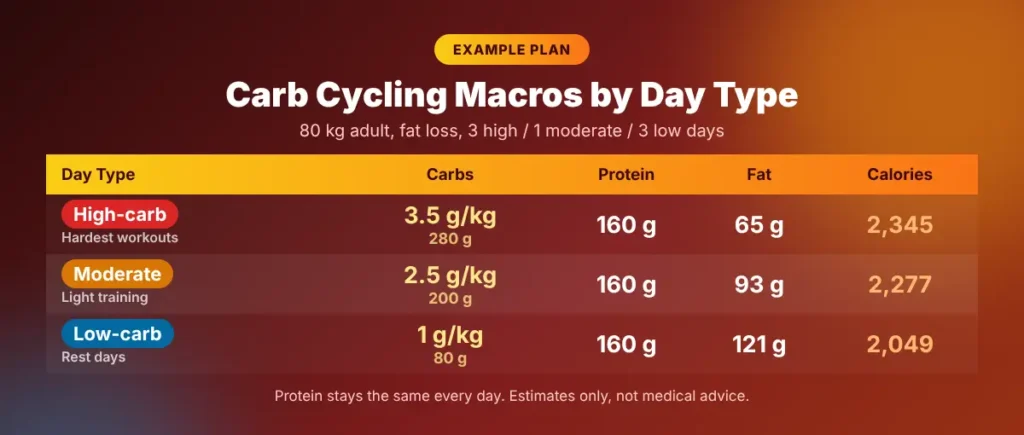
Calories on each day come from these macros (4 kcal per gram of carbs and protein, 9 kcal per gram of fat).
Carb Cycling Calculator for Weight Loss
For weight loss, the calculator sets your average daily calories about 20% below your estimated maintenance (calculated from your age, weight, height and activity) and spreads carbs across the week. Weight loss comes mainly from the weekly calorie deficit, not from any special effect of high or low days. Low-carb days make the deficit easier to create, and high-carb days fuel your hard workouts. The calculator will not go below 1,500 kcal for men or 1,200 kcal for women.
How Do I Plan a Carb Cycling Week With Training and Rest Days?
- List your training days and mark your hardest sessions (for example legs or back).
- Put high-carb days on your hardest workouts. Most plans use 2 to 3 high-carb days a week.
- Use moderate-carb days for lighter sessions such as upper body or moderate cardio.
- Make rest days low-carb.
Example week:
| Day | Training | Carb day |
|---|---|---|
| Mon | Legs | High |
| Tue | Light cardio or upper body | Moderate |
| Wed | Back and biceps | High |
| Thu | Rest | Low |
| Fri | Chest and shoulders | High |
| Sat | Rest or easy walk | Low |
| Sun | Rest | Low |
Move the days around to match your own schedule.
What to Eat on High-Carb and Low-Carb Days
- High-carb days: rice, roti, oats, potatoes, bananas and other fruit, lentils, along with lean protein
- Low-carb days: eggs, chicken, fish, paneer or tofu, vegetables, nuts, olive oil and curd
- Protein every day: the same grams, from chicken, fish, eggs, dairy, lentils, soya or a protein shake if needed
Choose mostly whole, unprocessed carbs. High-carb days are not cheat days.
Is Carb Cycling Good for Losing Fat Without Losing Muscle?
It can be, but not because of the cycling itself. Research reviews say that when calories and protein are matched, carb cycling gives similar fat loss to a steady moderate-carb diet. Muscle is protected by:
- Enough protein (about 1.6–2.2 g/kg every day)
- Resistance training (lifting weights)
- A moderate calorie deficit instead of a crash diet
Carb cycling may help some people stick to their diet and train harder on high-carb days. If you find it hard to follow, a simple, consistent plan with enough protein works just as well.
Does Carb Cycling Work Better Than Other Diets?
Current evidence does not show that carb cycling is better for fat loss than other calorie-matched diets. Claims such as “it resets your metabolism” are not well supported. Its main benefit is flexibility: more carbs around training and fewer on rest days.
Who Should Be Careful With Carb Cycling?
Talk to a doctor or dietitian first if you are pregnant or breastfeeding, have diabetes or take insulin, have kidney disease, have a history of disordered eating, are under 18, or take regular medication. Strict low-carb days can affect blood sugar and energy.
Common Mistakes
- Cutting protein on low-carb days
- Eating too few calories overall
- Treating high-carb days as cheat days
- Using high-carb days without hard training
- Changing the plan every week instead of tracking results for 3–4 weeks
Related Tools
Frequently Asked Questions About Carb Cycling
How many carbs should I eat on high and low carb days?
Eat about 3–5 g of carbs per kg of body weight on high-carb days and about 0.5–2 g per kg on low-carb days, depending on your goal. For an 80 kg adult on a fat-loss plan, that is roughly 280 g on high days and 80 g on low days. Moderate days sit in between, around 2–3.5 g per kg. Use the calculator above to get numbers for your own weight and goal.
What is the carb cycling calculator for weight loss?
It is a tool that estimates your daily calories and gives you high, moderate and low carb day macros, so you can create a weekly calorie deficit while keeping protein high. For fat loss, it sets calories about 20% below your estimated maintenance on average. It is a starting estimate, so adjust it after tracking your progress for a few weeks.
How do I plan a carb cycling week with training and rest days?
Put high-carb days on your hardest workouts, moderate days on lighter sessions and low-carb days on rest days. Most plans use 2 to 3 high-carb days a week. Keep protein the same every day, and move the days around to fit your own training schedule.
Carb cycling macros: how much protein, carbs and fat per day?
Protein stays constant at about 1.6–2.2 g per kg every day. Carbs change by day type: about 3–5 g/kg on high days, 2–3.5 g/kg on moderate days and 0.5–2 g/kg on low days. Fat fills the remaining calories, so it is higher on low-carb days and lower on high-carb days. For an 80 kg adult losing fat, that is about 160 g protein daily, with carbs and fat as in the table above.
Is carb cycling good for losing fat without losing muscle?
It can be, as long as protein is high (about 1.6–2.2 g/kg), you lift weights and your calorie deficit is moderate. Research shows similar fat loss to other calorie-matched diets, so the cycling is not what protects muscle. It may simply help you train harder and stick to the plan.
How many high-carb days per week should I have?
Most plans use 2 to 3 high-carb days a week, matched to your hardest workouts. The calculator lets you choose 1 to 4.
How many calories should I eat on a carb cycling diet?
For fat loss, about 15–20% below your maintenance on average across the week. The calculator gives an estimate from your age, weight, height and activity.
Do I need to count macros for carb cycling?
Yes, at least loosely. The main targets are protein every day and carbs for each day type.
Is carb cycling safe?
For healthy adults it is generally safe when calories and protein are adequate. Talk to your doctor first if you have a medical condition, are pregnant or take medication.
Bottom Line
Eat about 3–5 g/kg of carbs on high days and 0.5–2 g/kg on low days, keep protein at 1.6–2.2 g/kg every day, and let fat fill the rest. It can help you train well while losing fat, but it is not magic: your total calories, protein and training matter most. Use the carb cycling calculator above to get your own plan.
References
- Roberts BM, Helms ER, Trexler ET, Fitschen PJ. Nutritional recommendations for physique athletes. Journal of Human Kinetics. 2020.
- Morton RW, et al. A systematic review, meta-analysis and meta-regression of the effect of protein supplementation on resistance training-induced gains in muscle mass and strength. British Journal of Sports Medicine. 2018.
- Jäger R, et al. International Society of Sports Nutrition position stand: protein and exercise. Journal of the International Society of Sports Nutrition. 2017;14:20.
- Aragon AA, et al. International Society of Sports Nutrition position stand: diets and body composition. Journal of the International Society of Sports Nutrition. 2017;14:16.
Disclaimer
This article is for educational purposes only and is not medical or dietitian advice. Always consult your doctor or a registered dietitian.