
First, note that this Wilks calculator is for personal comparison only. In addition, score levels are informal and differ between sources. Finally, the IPF no longer uses the Wilks formula for official rankings.
🏋 Wilks Calculator
Calculate your Wilks score from your squat, bench press and deadlift total.
Your Wilks Results
How to Use the Wilks Calculator
Choose your sex and unit (kg or lb).
Enter your body weight.
Enter your best squat, bench press and deadlift. If you only know your total, type it in the total box instead.
Tap Calculate Wilks Score. You get your Wilks score, coefficient, level and the total you need to reach the next level.
Wilks Calculator: What Is a Good Wilks Score in Powerlifting?
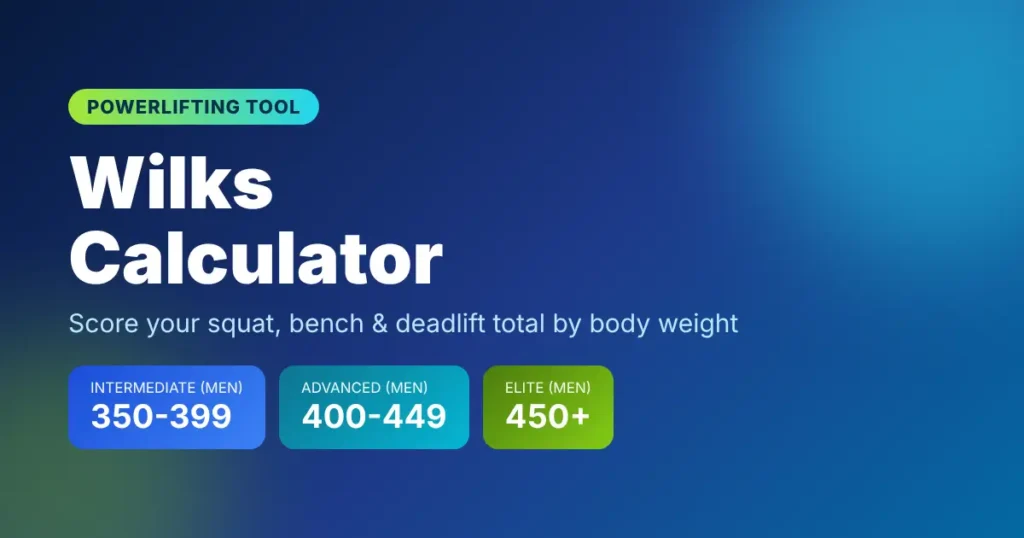
For example, a good Wilks score for a man is about 350 to 400. In addition, a score above 400 counts as advanced. Similarly, for women, a good score is about 300 to 350, and above 350 is advanced. In addition, scores of 450 or more for men (400 or more for women) are elite. Finally, enter your squat, bench press and deadlift in the Wilks calculator below to get your own score.
Overall, the Wilks score lets you compare powerlifters of different body weights. For instance, a 70 kg lifter and a 120 kg lifter can lift very different totals, but you can still compare their Wilks scores fairly. Finally, this guide explains how to work out the score, what the levels mean, and how to compare your total with others.
How to Use the Wilks Calculator
- First, choose your sex and unit (kg or lb).
- Next, enter your body weight.
- Then, enter your best squat, bench press and deadlift. In addition, if you only know your total, type it in the total box.
- Finally, tap “Calculate Wilks Score.” As a result, you get your score, coefficient, level and the total you need to reach the next level.
Above all, use your best one-rep max lifts, not rep sets.
What Is the Wilks Score?
Overall, the Wilks score is a number that adjusts your powerlifting total for your body weight. Because heavier lifters can lift more, the formula gives a bigger multiplier to lighter lifters and a smaller multiplier to heavier ones. Finally, Robert Wilks created the formula, so it carries his name.
In short, your total is the sum of your best squat, bench press and deadlift.
Wilks Calculator for Squat, Bench and Deadlift Total
First, the calculator adds your three lifts to get your total. Then, it works out the Wilks coefficient for your body weight and sex, and multiplies the two. Finally, if you only know your total, you can enter it directly.
For example, a man who weighs 82 kg lifts a 180 kg squat, 120 kg bench and 220 kg deadlift. As a result, his total is 520 kg. In fact, his coefficient is 0.6724. Therefore, his Wilks score is 520 × 0.6724 = 349.6.
How Is the Wilks Coefficient Calculated?
In fact, the coefficient comes from a fifth-degree polynomial based on body weight in kg:
Coefficient = 500 ÷ (a + b×BW + c×BW² + d×BW³ + e×BW⁴ + f×BW⁵)
Wilks score = total (kg) × coefficient
In addition, the constants a to f are different for men and women. For men they are:
- a = −216.0475144
- b = 16.2606339
- c = −0.002388645
- d = −0.00113732
- e = 7.01863 × 10⁻⁶
- f = −1.291 × 10⁻⁸
First, real competition results shaped the formula. As a result, it works within normal competition body weights. Outside this range, however, scores become less accurate.
Wilks Score Chart: Beginner to Elite
First, levels are informal, and different websites use different ranges. Therefore, this chart uses one common scale:
| Level | Men | Women |
|---|---|---|
| Beginner | below 300 | below 250 |
| Novice | 300–349 | 250–299 |
| Intermediate | 350–399 | 300–349 |
| Advanced | 400–449 | 350–399 |
| Elite | 450–499 | 400–449 |
| World-class | 500+ | 450+ |
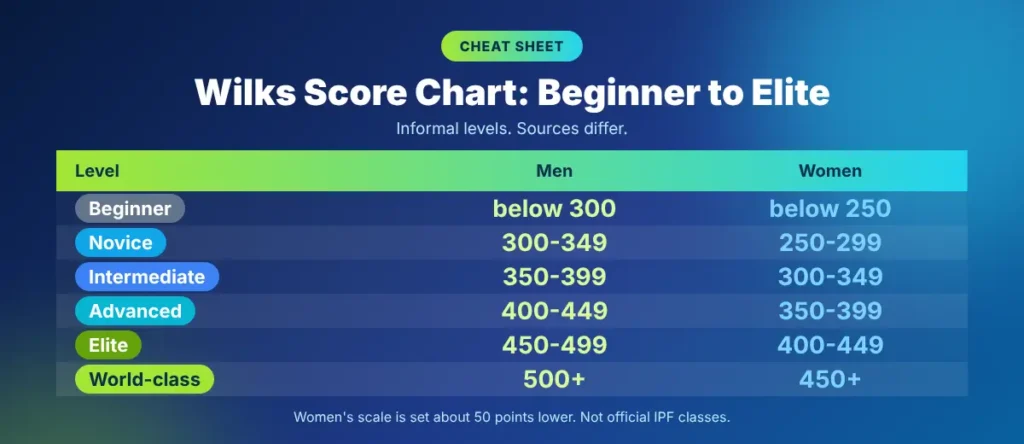
Similarly, the women’s column sits about 50 points lower, which is how many guides present it. In addition, these levels are not official IPF classes.
What Total Do You Need for Each Level?
Because the coefficient changes with body weight, the total you need changes too.
Men:
| Body weight | Total for 350 Wilks | Total for 400 Wilks | Total for 450 Wilks |
|---|---|---|---|
| 60 kg | 410 kg | 469 kg | 528 kg |
| 70 kg | 467 kg | 534 kg | 600 kg |
| 80 kg | 513 kg | 586 kg | 659 kg |
| 90 kg | 548 kg | 627 kg | 705 kg |
| 100 kg | 575 kg | 657 kg | 739 kg |
| 110 kg | 595 kg | 680 kg | 765 kg |
Women:
| Body weight | Total for 300 Wilks | Total for 350 Wilks | Total for 400 Wilks |
|---|---|---|---|
| 50 kg | 234 kg | 272 kg | 311 kg |
| 60 kg | 269 kg | 314 kg | 359 kg |
| 70 kg | 302 kg | 352 kg | 402 kg |
| 80 kg | 328 kg | 383 kg | 437 kg |
| 90 kg | 347 kg | 405 kg | 463 kg |
How Do I Compare Powerlifting Totals Across Different Body Weights?
First, follow these steps:
- First, find each lifter’s total (squat + bench + deadlift in kg).
- Next, find each lifter’s Wilks coefficient from their body weight and sex.
- Then, multiply the total by the coefficient.
- Finally, compare the scores. In other words, the higher score is relatively stronger.
First, use the same formula for everyone. In addition, Wilks, Wilks2 and IPF GL Points give different numbers. Therefore, do not mix them.
Is the Wilks Formula Still Used?
Not officially. First, the IPF started using IPF GL (Good Lift) Points in 2020 to replace Wilks. Next, a newer version called Wilks2 also appeared in 2020. Finally, researchers have also noted a drawback: the original Wilks formula came from older equipped lifting results. In fact, critics call it unfair to very heavy and very light lifters, particularly in the deadlift.
Even so, many lifters still use Wilks to track personal progress, because it is simple and widely known. For official meets, however, check which formula the federation uses.
How Can I Increase My Wilks Score?
- First, raise your total: the best way is to get stronger in all three lifts
- Next, train the weakest lift to balance your total
- Then, compete at a weight where you are strongest for your size
- Finally, recover well: eat enough protein and calories and sleep well
Related Tools
- Steps to Miles Calculator
- Calories Burned by Activity Calculator
- Pace Calculator
- Running Calories Calculator
- Rucking Calorie Calculator
- Treadmill Calorie Calculator
- One Rep Max Calculator
Frequently Asked Questions About the Wilks Score
What is a good Wilks score in powerlifting?
First, for men, about 350–400 is good and 400 or more is advanced. Similarly, for women, about 300–350 is good and 350 or more is advanced. Finally, levels differ between sources.
How is the Wilks coefficient calculated?
First, divide 500 by a fifth-degree polynomial of your body weight in kg. Next, note that the constants differ for men and women. Finally, multiply your total by the coefficient to get your Wilks score.
How do I compare powerlifting totals across different body weights?
First, multiply each lifter’s total by their Wilks coefficient and compare the scores. Then, use the same scoring formula for everyone.
What is the Wilks score chart from beginner to elite?
For example, common levels for men are below 300 (beginner), 300–349 (novice), 350–399 (intermediate) and 400–449 (advanced). In addition, 450–499 (elite) and 500+ (world-class) are also common levels for men. Similarly, women’s levels are about 50 points lower.
Is a Wilks score of 400 good?
Yes. For men, 400 is the start of the advanced range. In addition, for women it is well above intermediate.
What is the difference between Wilks and IPF GL points?
First, IPF GL Points replaced Wilks as the IPF’s official formula in 2020. In fact, they use a different calculation. As a result, scores are not the same.
Can I use the Wilks calculator in pounds?
Yes. In fact, the calculator converts pounds to kilograms for you.
Does the Wilks score include bench-only or deadlift-only meets?
Lifters usually use the Wilks formula with the full three-lift total. In addition, you can enter any total, but the levels apply to the full total.
Bottom Line
In summary, a Wilks score of about 350–400 is good for men and 300–350 for women. In fact, above 400 (men) or 350 (women) is advanced. Overall, the score adjusts your total for body weight. As a result, you can compare lifters of different sizes. Finally, enter your lifts in the Wilks calculator above to see where you stand.
References
- Wikipedia. Wilks coefficient. en.wikipedia.org
- Peyen J, Nuermaimaiti R, Cunningham J. Discussing Diminishing Returns: A New Scoring System for Powerlifting. arXiv:2503.13040, 2025.
- Khudayarov A. Revising the Wilks Scoring System for pro RAW Powerlifting. arXiv:1903.10694, 2019.
- Vanderburgh PM, Batterham AM. Validation of the Wilks powerlifting formula. Medicine & Science in Sports & Exercise. 1999.
Disclaimer:
This article is for informational purposes only. In addition, score levels are informal and vary between sources.