

How Do I Calculate My Pre-Pregnancy BMI in Kg and Cm, and How Much Weight Should I Gain?
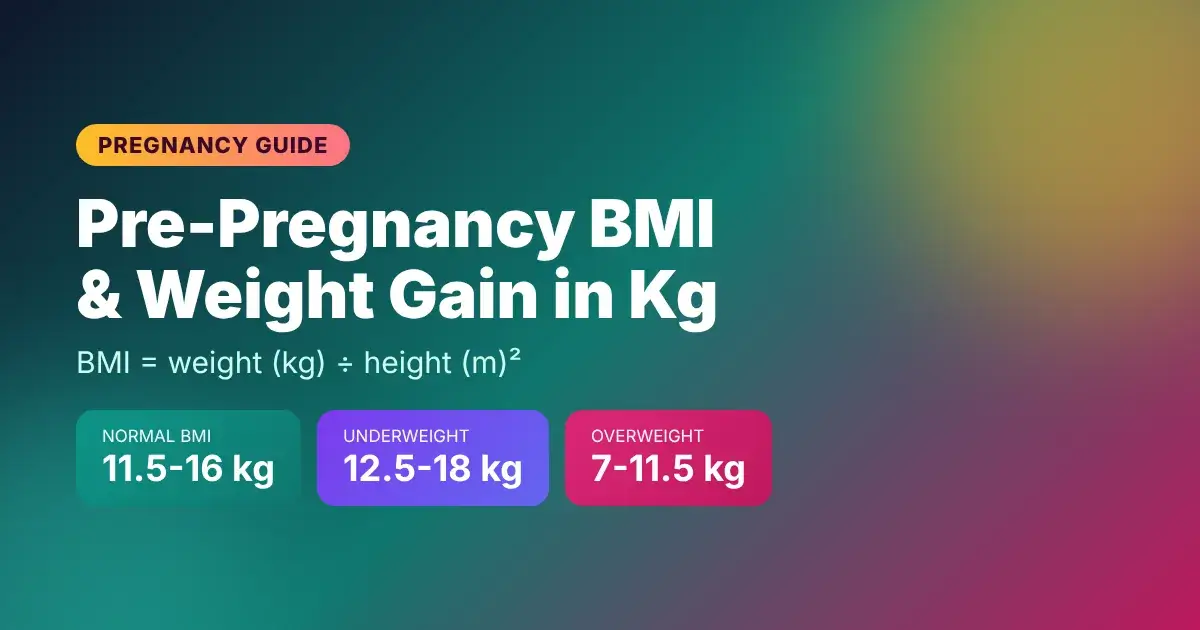
To calculate your pre-pregnancy BMI, divide your weight in kg by your height in metres squared. If you use cm, divide your weight by (height in cm × height in cm) and multiply by 10,000. Then check your BMI category. If you are underweight (BMI below 18.5), gain 12.5 to 18 kg. With a normal BMI (18.5 to 24.9), gain 11.5 to 16 kg. If you are overweight (25 to 29.9), gain 7 to 11.5 kg. If you are obese (30 or more), gain 5 to 9 kg.
Please note: This article is for general information only and is not medical advice. Your doctor or midwife will advise you on the right weight gain for your pregnancy.
What Is the Formula for BMI Using Kg and Cm?
BMI = weight (kg) ÷ [height (cm) ÷ 100]²
You can also write it as: BMI = weight (kg) ÷ (height in cm × height in cm) × 10,000
Follow these steps:
- Write your weight before pregnancy in kg.
- Convert your height to metres by dividing the cm by 100.
- Multiply the height in metres by itself.
- Divide your weight by that number.
Example: a woman weighs 60 kg and is 160 cm tall.
- Height in metres: 1.60
- 1.60 × 1.60 = 2.56
- BMI = 60 ÷ 2.56 = 23.4
Use your weight before pregnancy. If you do not know it, use your weight at your first antenatal visit (in the first trimester).
How Do I Calculate My Pre-Pregnancy BMI in Kg and Cm?
Use the formula above with your own numbers. Here are three more examples:
| Weight | Height | Calculation | BMI | Category |
|---|---|---|---|---|
| 52 kg | 165 cm | 52 ÷ (1.65 × 1.65) | 19.1 | Normal |
| 70 kg | 155 cm | 70 ÷ (1.55 × 1.55) | 29.1 | Overweight |
| 78 kg | 158 cm | 78 ÷ (1.58 × 1.58) | 31.2 | Obese |
What Is a Healthy Pre-Pregnancy BMI for Pregnancy?
A healthy pre-pregnancy BMI is 18.5 to 24.9 under the standard WHO categories used in most pregnancy guidelines.
| BMI | Category |
|---|---|
| Below 18.5 | Underweight |
| 18.5–24.9 | Normal weight |
| 25–29.9 | Overweight |
| 30 or more | Obese |
Asian BMI cut-offs: The WHO also suggests lower cut-offs for Asian populations: 18.5–22.9 is normal, 23–27.4 is overweight and 27.5 or more is obese. Some studies in Asian women suggest that a BMI above 23 may carry higher risks. Ask your doctor which categories they use for you, since your target range may differ.
How Much Weight Should I Gain by Pre-Pregnancy BMI?
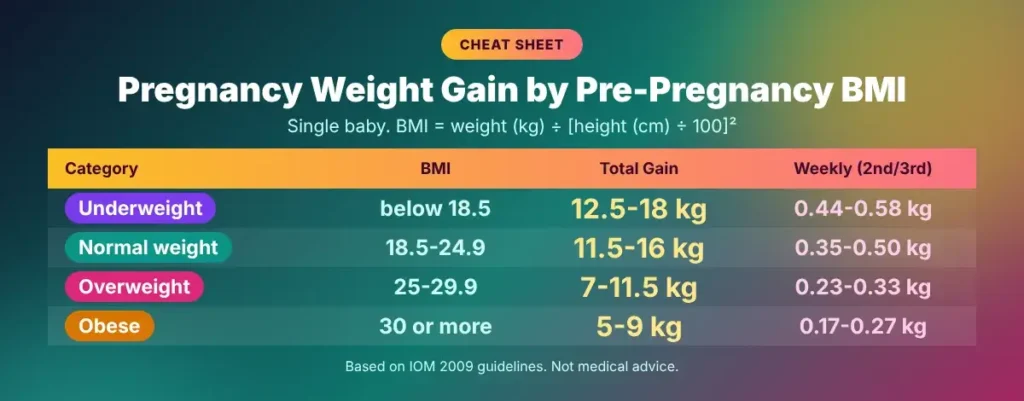
The US Institute of Medicine (IOM) 2009 guidelines give these totals for a single baby:
| Pre-pregnancy BMI | Category | Total gain | Weekly gain (2nd and 3rd trimester) |
|---|---|---|---|
| Below 18.5 | Underweight | 12.5–18 kg | 0.44–0.58 kg |
| 18.5–24.9 | Normal weight | 11.5–16 kg | 0.35–0.50 kg |
| 25–29.9 | Overweight | 7–11.5 kg | 0.23–0.33 kg |
| 30 or more | Obese | 5–9 kg | 0.17–0.27 kg |
In the first trimester, the recommended gain for all women is small, about 0.5 to 2 kg in total. Most of the weight is gained later.
How Much Weight Should I Gain If My Pre-Pregnancy BMI Is Underweight?
If your BMI is below 18.5, aim to gain 12.5 to 18 kg during pregnancy. This is the highest range, at about 0.44 to 0.58 kg per week after the first trimester. A higher gain helps your baby grow well and lowers the risk of a small baby.
Eat regular, balanced meals and snacks with enough protein, healthy fats and whole grains. If you have nausea, try small, frequent meals. Talk to your doctor if you are struggling to gain weight.
How Much Weight Should I Gain If My Pre-Pregnancy BMI Is Overweight or Obese?
If your BMI is 25 to 29.9 (overweight), aim to gain 7 to 11.5 kg. If your BMI is 30 or more (obese), aim for 5 to 9 kg. The weekly gain after the first trimester is about 0.23 to 0.33 kg for overweight and 0.17 to 0.27 kg for obese.
Do not diet or try to lose weight during pregnancy unless your doctor tells you to. Choose nutritious foods, stay active as advised and attend all antenatal visits. Your doctor may adjust your target based on your health.
Why Does My Pregnancy Weight Gain Range Depend on My BMI Before Pregnancy?
Your range depends on your BMI because your BMI shows how much body fat reserve you start with. A woman with less reserve needs to gain more to support the baby. A woman with more reserve needs to gain less.
Both too little and too much gain can raise risks:
- Too little weight gain is linked with a small baby (small for gestational age), low birth weight and preterm birth.
- Too much weight gain is linked with gestational diabetes, high blood pressure, caesarean delivery, a large baby and weight retained after birth.
The IOM ranges are set to keep these risks as low as possible for each BMI group.
What About Twins?
Twin pregnancies need more weight gain. The IOM provisional ranges for twins are about 17 to 25 kg for normal weight, 14 to 23 kg for overweight and 11 to 19 kg for obese women. There is no IOM guidance for underweight women carrying twins. Your doctor will guide you.
Is It Normal to Gain Weight Unevenly?
Yes. Weight gain is rarely steady. Many women gain very little early on, especially with morning sickness, and more in the second and third trimesters. What matters most is the overall trend and your baby’s growth on scans.
When Should I Talk to My Doctor?
Speak to your doctor or midwife if:
- You are losing weight or cannot keep food or drink down
- You are gaining much faster or slower than expected
- You notice sudden swelling in the face or hands, severe headaches or vision changes
- You have diabetes, high blood pressure or other health conditions
Related Tools
Frequently Asked Questions
How do I calculate my pre-pregnancy BMI in kg and cm, and how much weight should I gain?
Divide your weight in kg by your height in metres squared (or weight ÷ [cm × cm] × 10,000). Then gain 12.5–18 kg if underweight, 11.5–16 kg if normal, 7–11.5 kg if overweight and 5–9 kg if obese.
What is the formula for BMI using kg and cm?
BMI = weight (kg) ÷ [height (cm) ÷ 100]². For example, 60 kg and 160 cm gives 60 ÷ 2.56 = 23.4.
What is a healthy pre-pregnancy BMI for pregnancy?
A BMI of 18.5 to 24.9 is considered healthy. For Asian women, the WHO suggests 18.5 to 22.9 as normal.
How much weight should I gain if my pre-pregnancy BMI is underweight?
Gain 12.5 to 18 kg, at about 0.44 to 0.58 kg per week after the first trimester.
How much weight should I gain if my pre-pregnancy BMI is overweight or obese?
Gain 7 to 11.5 kg if overweight and 5 to 9 kg if obese.
Why does my pregnancy weight gain range depend on my BMI before pregnancy?
Because your BMI shows your starting body reserves. Lower-BMI women need more gain, and higher-BMI women need less, to lower the risks linked with too little or too much weight gain.
Which weight should I use to calculate my BMI?
Use your weight before pregnancy, or your first weight in early pregnancy if you do not know it.
Does my weight gain target change with my height?
The target is based on BMI, which already uses your height. So two women of different heights can fall in the same range.
Should I try to lose weight if I am overweight in pregnancy?
No, not unless your doctor advises it. Aim for the recommended, lower gain range instead.
Bottom Line
To find your pre-pregnancy BMI, divide your weight in kg by your height in metres squared. Then follow your range: 12.5–18 kg if underweight, 11.5–16 kg if normal, 7–11.5 kg if overweight and 5–9 kg if obese. Your doctor can help you set the right target.
References
- Institute of Medicine and National Research Council (2009). Weight Gain During Pregnancy: Reexamining the Guidelines. National Academies Press.
- Gilmore LA, et al. Weight gain in pregnancy and application of the 2009 IOM guidelines. Obesity. 2015.
- Zhang CX, et al. Optimal gestational weight gain in Chinese pregnant women by Chinese-specific BMI categories. Public Health Nutrition. 2021.
- Lee JY, et al. Determining optimal gestational weight gain in the Korean population: a retrospective cohort study. Reproductive Biology and Endocrinology. 2017;15:87.
- Morisaki N, et al. Pre-pregnancy BMI-specific optimal gestational weight gain for women in Japan. Journal of Epidemiology. 2017;27(10):492–498.
Disclaimer
This article is for educational purposes only and is not medical advice. Always consult your doctor or midwife.