
Please note: This fundal height calculator is for general information only and is not medical advice. Only your doctor or midwife can assess your baby’s growth. If you are worried about your measurement, speak to your healthcare provider.
📏 Fundal Height Calculator
Find the normal fundal height (cm) for your week of pregnancy and check your own measurement.
Your Fundal Height Results
How to Use the Fundal Height Calculator
Enter how many weeks pregnant you are, and extra days if you know them. Or enter your due date instead.
Add your measurement (optional). Type the fundal height in cm that your doctor or midwife recorded.
Tap Calculate Fundal Height. You will see the expected height, the normal range and how your measurement compares.
Fundal Height Calculator: What Should Your Fundal Height Be by Week?
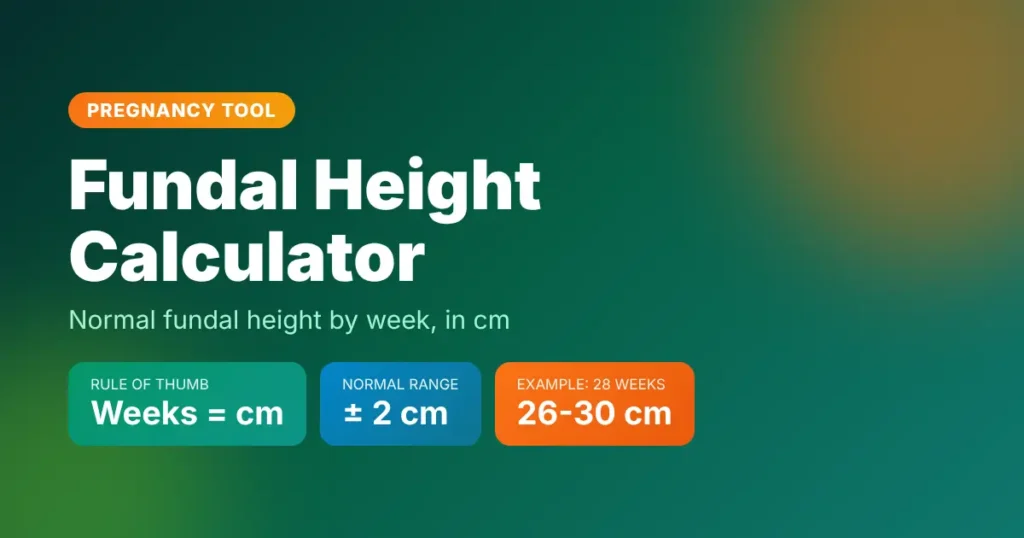
What should your fundal height be at 28 weeks pregnant? At 28 weeks, a normal fundal height is about 28 cm, with an acceptable range of 26 to 30 cm. After about 20 to 24 weeks, fundal height in centimetres roughly matches the number of weeks you are pregnant, give or take 2 cm. Enter your weeks of pregnancy in the fundal height calculator below to see your expected measurement and normal range, and add your own reading to compare.
Fundal height is one of the simplest checks at antenatal visits, but the numbers can raise questions. This guide explains how it is measured, what is normal week by week, what a reading that is 2 cm bigger or smaller means, and when doctors suggest a scan.
How to Use the Fundal Height Calculator
- Enter your weeks of pregnancy, and extra days if you know them. Or enter your due date instead.
- Add your measurement (optional). Type the fundal height in cm that your doctor or midwife recorded.
- Tap “Calculate Fundal Height.” You see the expected height, the normal range and how your measurement compares.
What Is Fundal Height?
Fundal height is the distance from your pubic bone to the top of your uterus (the fundus), measured in centimetres. Doctors and midwives use it to check that your uterus, and so your baby, is growing at the expected rate. It is a quick, safe screening tool with no risks.
What Should My Fundal Height Be at 28 Weeks Pregnant?
At 28 weeks, the expected fundal height is about 28 cm. A reading from 26 to 30 cm is considered within the normal range. The same rule works at other weeks: expected height in cm is about your weeks of pregnancy, plus or minus 2 cm. At 24 weeks, for example, about 24 cm is expected, and 22 to 26 cm is acceptable.
Fundal Height Chart by Week in cm
| Weeks pregnant | Expected fundal height | Normal range |
|---|---|---|
| 20 weeks | 20 cm | 18–22 cm |
| 22 weeks | 22 cm | 20–24 cm |
| 24 weeks | 24 cm | 22–26 cm |
| 26 weeks | 26 cm | 24–28 cm |
| 28 weeks | 28 cm | 26–30 cm |
| 30 weeks | 30 cm | 28–32 cm |
| 32 weeks | 32 cm | 30–34 cm |
| 34 weeks | 34 cm | 32–36 cm |
| 36 weeks | 36 cm | 34–38 cm |
| 38 weeks | 38 cm | 36–40 cm |
| 40 weeks | 40 cm | 38–42 cm |
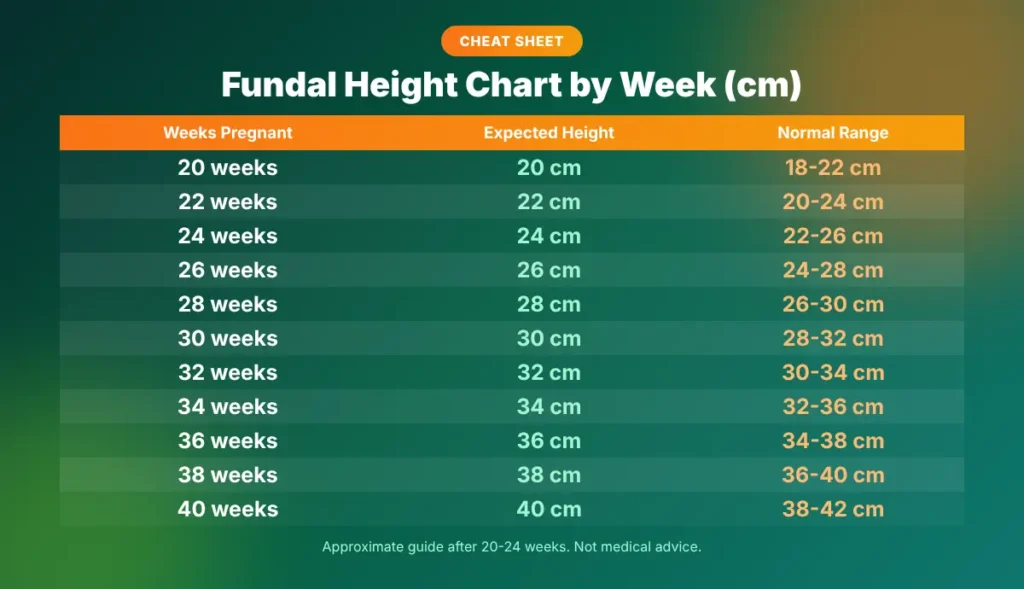
This is an approximate guide. Many providers start measuring at around 20 to 24 weeks, and the measurement becomes less accurate towards the end of pregnancy, when the baby moves lower into the pelvis.
Fundal Height Calculator by Weeks of Pregnancy
The calculator above uses the standard rule, often called McDonald’s rule: fundal height in cm is roughly equal to the weeks of pregnancy, plus or minus 2 cm. It takes your weeks (or due date) and shows the expected height and range. If you add your measured height, it tells you whether it is within the normal range, slightly outside, or far enough off that your doctor may suggest an ultrasound. It cannot replace a clinical measurement.
How Is Fundal Height Measured in Pregnancy?
Your doctor or midwife measures it at antenatal visits:
- You usually lie on your back, and it helps to have an empty bladder.
- They find the top of your uterus by feeling your belly.
- They place a tape measure at the top of your pubic bone and stretch it to the top of the uterus.
- They note the number in centimetres.
When it is first measured depends on the provider, but it usually starts between 20 and 24 weeks and continues at each visit. A measurement taken by the same person each time is more useful for tracking growth, because small differences between people are common.
Where Should the Top of the Uterus Be at Each Stage?
| Pregnancy stage | Where the top of the uterus is felt |
|---|---|
| 12–14 weeks | Just above the pubic bone |
| About 16 weeks | Between the pubic bone and the navel |
| 20–22 weeks | Around the navel |
| About 36 weeks | Near the breastbone (lower ribs) |
| 37–40 weeks | May drop slightly as the baby settles lower |
Is It Normal If My Fundal Height Measures 2 cm Bigger or Smaller?
Yes. A measurement within 2 cm of your weeks of pregnancy is considered normal. For example, a reading of 26 to 30 cm at 28 weeks is within the expected range. Fundal height is not an exact measure, and the error can be up to about 2 to 3 cm depending on who measures, your body shape and your baby’s position.
If you are more than 2 cm away from the expected number, it does not always mean a problem, but your provider may re-measure at the next visit or suggest an ultrasound. A difference of 3 cm or more usually leads to an ultrasound scan to check your baby’s growth and the amount of amniotic fluid.
What Can Make Fundal Height Measure Bigger or Smaller?
A reading can be higher or lower than expected for many reasons, and most are harmless:
- Baby’s position and size: a baby lying across the belly or sitting low can change the reading
- Amniotic fluid: too much or too little fluid can change the size of the uterus
- Due date: an error in the estimated due date shifts the expected number
- Body weight (BMI): a higher BMI can make the measurement less accurate
- Fibroids or a full bladder: these can raise the reading
- Twins or more babies: the uterus is usually larger than expected
- Slower growth: sometimes a small reading means the baby is not growing as well as expected, which is why a scan is advised
Only an ultrasound and your doctor’s assessment can tell the reason.
When Should I Talk to My Doctor?
Speak to your doctor or midwife if your fundal height is more than 2 cm off the expected number, if your measurements are not increasing from visit to visit, or if you notice that your baby’s movements have decreased. Do not wait for your next appointment if you are worried about reduced movements.
Related Tools
- Due Date Calculator
- Ovulation Calculator
- IVF Due Date Calculator
- Conception Date Calculator
- Pregnancy Weight Gain Calculator
- Ultrasound Due Date Calculator
- Gestational Age Calculator
Frequently Asked Questions About Fundal Height
What should my fundal height be at 28 weeks pregnant?
About 28 cm, with a normal range of 26 to 30 cm.
What is the fundal height chart by week in cm?
After about 20 to 24 weeks, the expected fundal height in cm equals your weeks of pregnancy, plus or minus 2 cm. For example, 24 cm at 24 weeks, 30 cm at 30 weeks and 36 cm at 36 weeks. See the chart above for 20 to 40 weeks.
How is fundal height measured in pregnancy?
A doctor or midwife uses a tape measure to measure from the top of your pubic bone to the top of your uterus, usually while you lie on your back. The number is recorded in centimetres at each antenatal visit.
Is it normal if my fundal height measures 2 cm bigger or smaller?
Yes. A difference of up to 2 cm either way is within the normal range. A difference of 3 cm or more usually leads to an ultrasound scan to check your baby, though many scans turn out normal.
What is the fundal height calculator by weeks of pregnancy?
It is a tool that gives the expected fundal height and normal range for your week of pregnancy and compares it with your measurement. Use the calculator above.
When does fundal height start to be measured?
Usually between 20 and 24 weeks, and then at most antenatal visits.
Is fundal height accurate?
It is a useful screening tool, but not exact. The result can vary by several centimetres depending on the person measuring, your baby’s position and your body shape. It is used alongside ultrasound.
Why is my fundal height measuring small?
A small measurement can be due to the baby’s position, a different due date, low amniotic fluid or slower growth. An ultrasound can check the reason.
Why is my fundal height measuring large?
It can be due to a larger baby, extra amniotic fluid, fibroids, twins or a different due date. Your doctor may suggest a scan to check.
Does fundal height change when the baby drops?
Yes. Near the end of pregnancy, when the baby moves lower into the pelvis, the measurement may stop rising or drop slightly and is less accurate.
Can I measure my own fundal height at home?
You can try, but results are often unreliable. Measuring needs training and consistency, so leave it to your doctor or midwife.
Bottom Line
Fundal height in centimetres is roughly the same as your weeks of pregnancy, plus or minus 2 cm, after about 20 to 24 weeks. At 28 weeks, that means about 28 cm, with 26 to 30 cm in the normal range. Use the fundal height calculator above to check your expected range, and talk to your doctor or midwife about any measurement that is more than 2 to 3 cm off.
References
- Cleveland Clinic. Fundal Height: Measurement, What It Means & Accuracy. my.clevelandclinic.org
- Medical News Today. Fundal height: What it means, by week, and accuracy. medicalnewstoday.com
- Wikipedia. Fundal height (McDonald’s rule). en.wikipedia.org
- FamilyEducation. Fundal Height Chart and Fetal Height: Measuring Your Baby. familyeducation.com
Disclaimer
This article is for educational purposes only and is not medical advice. Always consult your doctor or midwife.